






to QRZ
Latest Awards




Trials & Errors #85 - Astatic and the Early Ham Radio Microphone Biz
The invention of the microphone isn't credited to one individual. Instead, it was gradually developed over the years from 1870 to the modern day by a number of inventors, some famous and some not. Edison, for example, was one name involved in the development of the mic. Edison and another inventor, Emile Berliner, battled in the courts for fifteen years about who had earned the patent on the carbon microphone -- an invention that made a huge improvement in the telephone. Edison won that battle, likely due to his name and the number of lawyers he could afford to put on that case.
 For Emile Berliner, who was 25 at the time he sold his microphone rights to the Bell Telephone Company, it was only one of a number of wild inventions that came from his workbench. Edison must have been further irked at Berliner in 1887 when the young, untrained inventor came up with the flat disc gramophone – a system of music still used today in vinyl records and far superior to Edison’s cylinders. Music was embedded in wavering grooves on a flat disc and read with a needle . . . a transducer converted the physical movement into electric signals.
In today's column, I'd like to focus on how microphones became a commercial business for ham radio operators. After all, there’s nothing more important to the phone operator than the way his or her voice sounds over the air, and this has a great deal to do with the microphone we’re speaking into.
The Rise of the Astatic Corporation
The Astatic Corporation is a historic American audio equipment manufacturer, one that was founded back in 1931 in my home state of Ohio. Astatic specialized in creating static-free microphones, phonograph pickups, and radio accessories, and its history is interesting to us because it was founded by a couple of ham radio operators who simply wanted to improve the sound of their voice in phone transmissions. It began the small industry later dominated by people like Bob Heil as sellers of Mics exclusively for radio use.
 Creed Chorpening was one of the many "radio boys" of amateur radio's early years. He fell in love with the hobby and intended to make radio his career later in life. Creed built his first station as 8WR out of West Virginia and later attended the Marconi Institute. The Marconi Institute had been set up by the corporation to churn out Morse Code operators and qualified radio technicians.
Creed took to radio in such a manner that his dreams moved from simply working the air as an amateur to the broadcasting business as it rapidly developed in the early 1920's (see #84l for more on this). When he moved North to Youngstown, Ohio, his entrepreneurial spirit began to show and with another gentleman (Warren Williamson, W8KT) he founded one of Ohio's first radio stations, WKBN AM radio. That station is still run by the Williamson family and can be heard from Cleveland to Pittsburgh PA. For a time, Alan Freed ran his radio show featuring early "Rock and Roll" music out of this Youngstown station.
 After meeting his wife Millie and marrying in 1924, another entrepreneurial itch struck Creed Chorpening, who was now W8MJM. He'd been frustrated by working in the 9-to-5 environment of a day to day job. Much of his pleasure came while he was at his workbench where he continued to build and experiment with amateur radio and other intriguing electrical apparatus.
Creed had a number of ideas come out of this period of time that he shared with his friend and fellow ham, Mr. F.H. Woodworth (W8AHW). Together, they explored different designs for microphones and other ham apparatus. When another ham friend joined them, Charles Semple, he shared ideas for the use of crystals in the mic design and an idea was born. Semple had been working with Rochelle salt crystals at a Cleveland area manufacturer of phono pickups and the three hams thought that there could be a future in using the same for microphones.
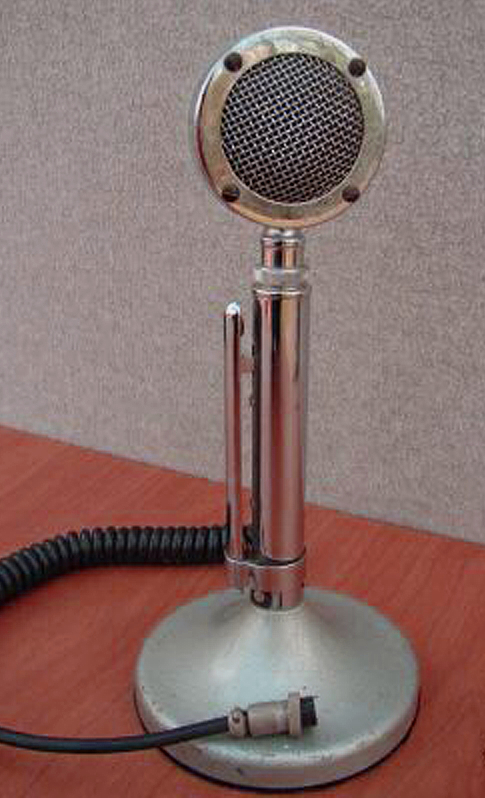
The three hams founded Astatic Microphone Lab (later Astatic Corporation) in 1933. Shortly afterwards production began on the world's first crystal radio mic, the D-104 (pictured to the left). Chorpening, as VP of R&D, was the technical brains behind the operation, while the other two hams built the business around these innovations.
The D-104 was immediately accepted by the amateur community and became affectionately known as the Silver Eagle mic. (There was a limited edition "Gold Eagle" produced for a time as well, with genuine 18k gold plating.) If you've got a Silver Eagle (or one of those rare Gold Eagles), won't you please join in the forum discussion below and tell us how it works in comparison to today's mics from the Japanese suppliers or companies like Heil? There have been many thousands of D-104's sold over the years.
Astatic moved into the design and production of defense equipment as well during WWII, with hydrophone and sonar devices for the military. But the company was best known for another curious type of microphone . . . one where users say that nothing EVER matched its sound.
 The Blues Harp
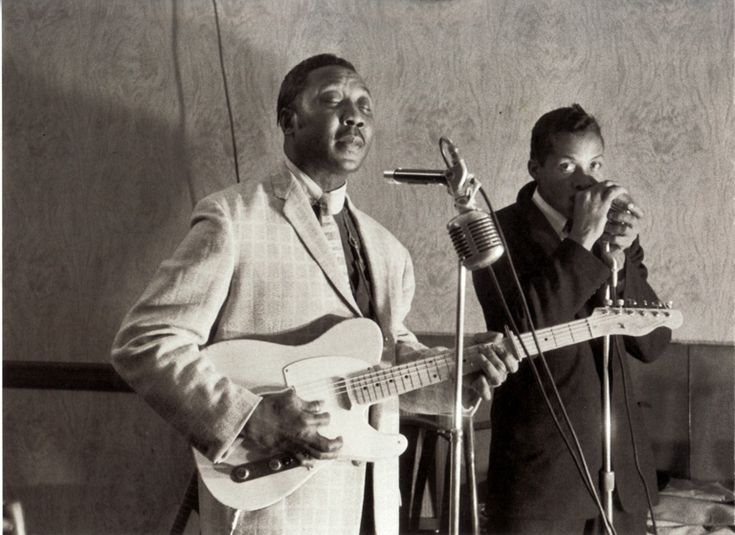
While this has nothing to do with ham radio, it's interesting because like radio, blues music draws passion and fans much like the best of amateur radio gear. The music of blues musicians, whether it from the deep South or an electrified band out of Chicago, blues must have a certain kind of sound. If the harmonica player is not using an Astatic JT-30 bullet mic with crystal cartridge, it's not going to have that raw and rugged sound quality that gave musicians like Little Walter or James Cotton their special sound. The mic was perfectly shaped to be held in the hand along with the harmonica. (Little Walter is shown at left with Muddy Waters.)
Astatic Corporation deserves a spot in the ham radio hall of fame for the Silver Eagle and other contributions to radio. And if you enjoy the blues, you've got two reasons to remember the company!
73 for now, Dave W7DGJ
Thanks for reading and each comment in the forum is appreciated and replied to . . .