QRZ.COM
ad: CommRadio-1
Please login help/register
callsign: password: secure login
Database News Forums Swapmeet Resources Contact
 11:34:36 UTC 22 May 2013 
Advanced Search Current Hot Callsigns XML Logbook Data QSL ListMaker Database Downloads DX Spotting Network Ham Club Database QSL Corner Top Web Contacts Expired Callsigns Daily Update Reports
Amateur Radio News General Announcements Special Events, Contests, etc. Hamfests and Conventions Silent Keys Headlines
Forums Home Discussions, Editorials, Talk Technical Forums Logging and Contesting
Swapmeet Hot List Ham Radio Gear for Sale Ham Radio Equipment Wanted and Trades Ham Made Gear General Merchandise Ham to Ham References Stolen Radios, Scams and Rip-offs
Site Menu... Practice Amateur Radio Exams Amateur Radio Study Guides Online License Renewals License Wall Certificates Commercial Ham Radio Links DX Country Atlas Grid Mapper Ham Radio Trivia Quiz Life Member Honor Roll
Help Desk, for accounts, lost passwords, etc. Add your callsign to QRZ Subscription Services Users Help Forum Frequently Asked Questions - FAQ QRZ en Espanol Privacy Statement Advertise with QRZ List of Current Advertisers About QRZ Donate to QRZ Contact us
ad: l-AmericanRadio
ad: l-assoc
ad: l-hrd-1
ad: l-innov
ad: l-ezhang
ad: l-Waters
ad: l-gcopper
ad: l-BCInc


  QSL image for AA6RE

AA6RE USA flag USA

Login is required for additional detail.


[+] Mailing label


[-]

Lookups:   6139 XML Subscriber

Email: Login required to view QSL: DIRECT, BUREAU OR LOTW

I have been a ham since about 1967. Original Novice call was WN6YIR, and when I upgraded to the Advanced class this became WB6YIR. I had to take my ham test up in San Francisco on Battery Street. Code tests had to be passed first and then the written tests were given after passing the code.

After college at UC Davis, I upgraded to Extra class and obtained my current call sign AA6RE. It is short call but that last "dit" sometimes gets lost in the noise.

I work CW almost exclusively because I have a poor antenna system and operate low power, 100 W. In the past (up till summer 2012) the antenna was an old AEA ISO-Loop antenna mounted at ground level. I recently (September 2012) upgraded from an ICOM-735 to a Kenwood TS-590. The ICOM had been used for 30 years along with its matching tuner and power supply. The TS-590 has much better interference rejection and the low noise is amzing compared to the 735. I now use a buddipole dipole in the backyard at about 12-15 feet. It seems to work better than my old ISO-Loop ground mounted antenna but at 15 feet directionality is not very good. I have made QRP contacts with it and the new TS-590.

On ten meters and often 15 meters, five watts works very well with the right number of sun spots! QRP work can be a challenge, but I now have 49 states confirmed on QRP and only need Rhode Island for all 50.

I visited a JT-65 at a session at Pacificon. It was very informative on the technology and its capability.

QSLing and contacting DX stations are great fun. I prefer paper QSLs, but I am an avid user of LOTW too. Even with a modest antenna, I have about 225 DXCC countries confirmed and over a 100 each on 10, 15, and 20 meters. I need another 60 countries for 100 countries on 40 meters. I doubt I have more than six countries on 80 meters and just one on 160 meters. It will probably take a new QTH to have success on DXCC on 80 meters! For 17 and 12 meters I need about anther 20 confirmed QSOs each.

IOTA totals are now 218. For me that was harder than 200 DXCC contacts, and the island QSL cards are often very nice!

CW is my main operating mode and I use a straight key. I have a keyer but have never felt comfortable sending code with the iambic paddle action. I am looking for a smooth straight key. Now I use an old key with a big Navy knob. I would like to get a Begali key a try sometime, but unless they show up at Pacificon I would have to buy one without trying it out.

Below is my old antenna. As you can see, the AEA Iso-Loop was ground mounted and required remote tuning as it had a very narrow bandwidth. I could operate 10 meters to 30 meters with it though. It is about 3 feet in diameter.

I also operated with a Butternut vertical and was pleased with it but had to remove it from my lot.

My AEA Iso-Loop Antenna: Ground level


My AEA Iso-Loop Antenna: Ground level


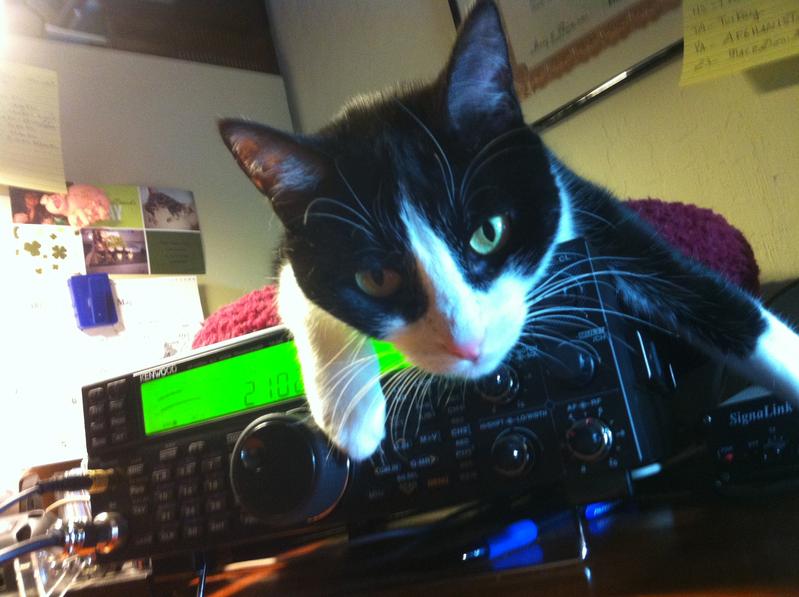
Here is my operating station plus the cat.

AA6RE Operating Station


Last modified: 2013-04-13 04:31:40, 5671 bytes cached

Login Required

Login is required for additional detail.


Apply for a new Vanity callsign...

This user has no active logs

Does this page contain inappropriate content? If so, Report this page...

Copyright © 2013 by QRZ.COM
Wed May 22 11:34:36 2013 UTC
CPU: 0.060 sec 26590 bytes