QRZ.COM
ad: CommRadio-1
Please login help/register
callsign: password: secure login
Database News Forums Swapmeet Resources Contact
 20:18:52 UTC 21 May 2013 
Advanced Search Current Hot Callsigns XML Logbook Data QSL ListMaker Database Downloads DX Spotting Network Ham Club Database QSL Corner Top Web Contacts Expired Callsigns Daily Update Reports
Amateur Radio News General Announcements Special Events, Contests, etc. Hamfests and Conventions Silent Keys Headlines
Forums Home Discussions, Editorials, Talk Technical Forums Logging and Contesting
Swapmeet Hot List Ham Radio Gear for Sale Ham Radio Equipment Wanted and Trades Ham Made Gear General Merchandise Ham to Ham References Stolen Radios, Scams and Rip-offs
Site Menu... Practice Amateur Radio Exams Amateur Radio Study Guides Online License Renewals License Wall Certificates Commercial Ham Radio Links DX Country Atlas Grid Mapper Ham Radio Trivia Quiz Life Member Honor Roll
Help Desk, for accounts, lost passwords, etc. Add your callsign to QRZ Subscription Services Users Help Forum Frequently Asked Questions - FAQ QRZ en Espanol Privacy Statement Advertise with QRZ List of Current Advertisers About QRZ Donate to QRZ Contact us
ad: l-AmericanRadio
ad: l-assoc
ad: l-gcopper
ad: l-ezhang
ad: l-BCInc
ad: l-Waters
ad: l-innov
ad: l-hrd-1


  QSL image for K4SO

K4SO USA flag USA

Login is required for additional detail.


[+] Mailing label


[-]

Lookups:   22385 Ham Member

Email: Login required to view QSL: SASE OKAY, BUT LOTW PREFERRED. SRI, NO BUREAU

Please note that I am no longer responding to cards via the bureau. After 42 years, I just can't justify the time or expense. Please consider using LoTW. I will work through the exisitng backlog, but no longer have envelopes at the bureau and appreciate all the hard work and time that is donated by the folks there. Please note also that cards I receive with SASEs go out the next day. Our local Post Offices DO NOT accept IRCs, so a US stamp or green stamp is sufficient.

There are a number of other pictures and information at www.k4so.com.

I've also got way too many pictures at picasaweb.google.com/kfoursoand also at picasaweb.google.com/kfourso2.

My father, N3ADT, Fred Killmon, on either Saipan or Tinian in late 1944 or 1945.

He was a radio operator on B-29s there in WWII.

There are new pictures, just found as we packed to move, at:

https://picasaweb.google.com/kfourso2/DadSWWIIPhotos


My father, Charles

I began in the hobby as a SWL, WPE3ICO, issued by Popular Electronics magazine. I recently found the original certificate, which had been stashed away in an envelope andis still in perfect shape. My father, N3ADT, brought home a BC-348Q and I strung a non-resonant antenna from my bedroom window on the second floor to a tree out back. It was probably only about 50 feet long and about 15 feet off of the ground. With no real idea where the bands were, I just cranked the spinner on the receiver and clunked the bandswitch until I found stations. I was hooked. I listened to international shortwave broadcasts for years as a "DXer" with the hardest thing often being listening for the exact frequency of the broadcast to obtain a QSL. I had no digital readout and the entire 49, 31 or 25 meter band was about 1 inch of tuning dial. It was a long while before I got hold of a World Radio and TV Handbook to look for broadcasts. Instead, I favored tuning the bands at about 20 minutes past or 10 minutes of the hour, listening for a new interval signal, then hoping the broadcast was in English. There were pilot lights (with filaments) and the smell of the tubes and components that carried hundreds of volts. It was magic.

My buddy just up the street, Mark, later WN3OYA also chased SWL DX with me and a few years later he found a ham to explain the requirements for a license to us. Our elmer was WA3KZX. Joe was an auto frame repair guy by day and he taught us the basics and gave us our novice tests. Mark got his license first, but I became nominally proficient with CW prior to being licensed, so I did a little operating from his station (I think the statute of limitations has run out on that infraction, at least I hope so.) A bit later, I was licensed as WN3PHG in Wilmington, DE in 1970 (my novice station, consisting of a Hammarlund HQ-129-X and Heathkit DX-40 is shown below, left). In the 1974 Field Day, operating as WA3LXK/4 in Nokeville, VA, my current QTH, I met other contesters that went on to enjoy real success in the sport, including K1AR (then WA2LQZ), N2IC (then WA2ICU), W2PA (then WB2AEH) and my now neighbor and friend, KT3Y (then WB4SGV). The ham who found the site for us was Will, WB4MRI, who is now Bill, KC7YWC, a pediatrician on the Navajo Indian Reservation. (That’s me using my Drake B-Line in our operating tent, below right.)

First station - WN3PHG - 1970Operating from Nokesville, VA in 1974 during Field Day.

I caught the contesting bug early with 64 Qs in the Novice Roundup in 1971. I was active as WA3PHG/4 from my first college dorm room at Chowan College in 1972-1974 using inverted vees, high in trees behind the dorm, with feedlines running out of our window. I ran a Drake B-Line and Eldico SSB-1000 from my desktop (the amp used a pair of 4CX250Bs and I bought from the father of a student at Chowan.) I even took the same room for both years, put the feedlines on the roof over the summer, and retrieved them when I returned the second year. My thanks to my roomate, and later best man, Matt, for putting up with my station.

I operated from the Rochester Institute of Technology (RIT) club station from 1974-1977, using a TA-33 (first HF yagi I had used), a Henry 2K-3 console amp and a Collins S/Line. That convinced me that DX chasing was something I'd like to pursue. After graduation I set up my Drake B-Line in our first apartment, much like I had in college, but on the ground floor, rather than the third. This made a more obvious installation, but I got away with it for a year. Thanks to KT3Y, (then /A41), I added a Heathkit Warrior to the mix and even ran RTTY. The Eldico amp had been sold to buy a set of tires for my Triumph Spitfire (1967 model). Newly married, the Drake station (as setup in our apartment, shown below) was my wife's first real introduction to ham radio. The color picture below my original Drake Line is the current one in our Amissville home. Thirty-five years later, she still indulges my involvement.

My shack in our first apartment, 1977-78

Drake Line at Amissville QTH

Nine years in our first house gave me a chance to put up my first tower (40 feet of Rohn 25), first tribander (a TA33 and later a TH6DXX), a wire beam for 40M and a 160M dipole, half of which was in my neighbor's yard. I got my first pair of 3-500s (Kenwood TL-922A) at that location and my first taste of serious SS contests as well as beginning to chase DX.

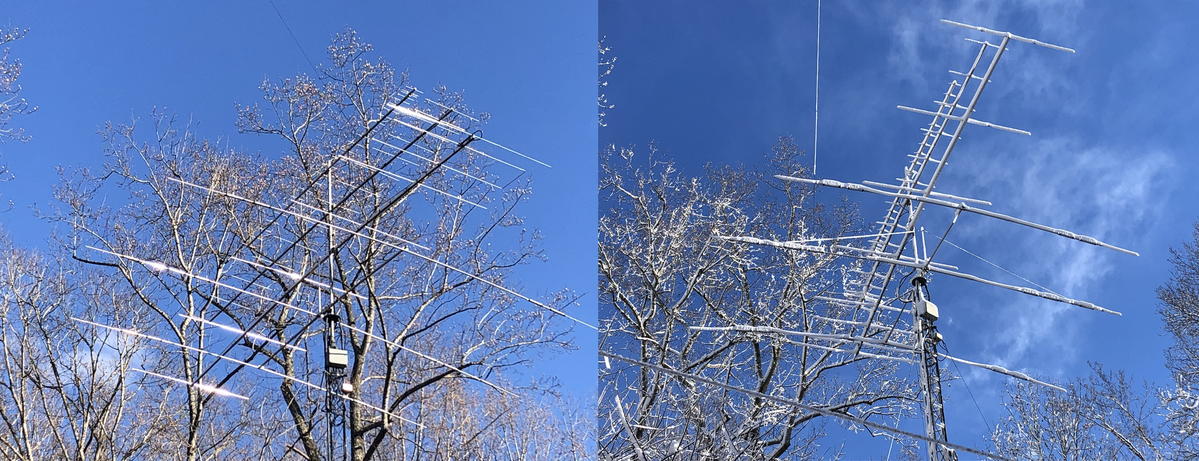
After spending over 24 years at my last QTH, I got the chance for more amps, rigs, and a bigger tower with more antennas including several monoband yagis. I was active on VHF from 1999 until around 2008, with capability on the bottom 4 bands, but tired of working the same guys over and over in contests, but not finding much activitiy in the interims. I have always enjoyed 6 meters though, because it's like 10M, but more so. It really is "the magic banc." I have confirmed DXCC and WAS on 6M, finishing DXCC after the move to Amisville. I also chase band countries, especially on 40, 80, and 160M. Due to shifts in my time priorities to my wife of 35 years, Diane, and our church, I don’t seriously contest very often or get up in the middle of the night to chase DX. It’s not a hardship. I had years of over-involvement, and it can still be a struggle not to allow the radio and related activities to consume too much time and energy. Currently, I’m trying to find a way to combine my hobby and work experience and use it in The Lord’s service. If you have ideas in that regard, please share them with me!

My 6M antenna was hung from an overhanging tree branch, and remained there long enough to finish up DXCC for that band here in Amissville. Next, I builta 2 element, two-band (10M and 17M) Moxon to my antenna "farm", which is hanging from that same spot and is turned by my ground-mounted rotator. The next antenna to be used there is a 4 element Cushcraft 10M monobander, which is about the heaviest thing I want to try with this technique.

My last few major construction projects included monoband amps for 6M and 160M with pix on my website. The 160M amp was sold before we moved, but the 6M amp is still in use. About 7 years ago , I was bitten by the vintage radio bug, and added a Drake B-Line (built in the 1970s) and a Collins S/Line, which celebrated its 50th birthday in 2008. I was able to use it to work stations at various Collins Radio locations during the commemoration of 50 years of the S/Line. An Elecraft K3 is now the primary "modern" rig, driving an Alpha 89 and it’s an amazing piece of gear, which continues to improve with firmware and hardware updates. NaP3 with LP-Pan and an EMU0202 sound card, have added a wide-screen panadapter to the K3. I can't imagine operating without it.

The photo at the top is representative of the first version of the shack in the unfinished basement. It was fun to build and use the antenna system and station at our last home, with my thanks to many who have helped me. Without their assistance, as paid professionals, or the generous assistance by great friends, I would never have had the extensive antenna system there.

If you’re checking this site because we had a QSO, thanks for the contact. Enjoy this hobby, it’s been a great one for me.

73, Mark


free counters

Last modified: 2013-05-19 19:42:31, 15111 bytes cached

Login Required

Login is required for additional detail.


Apply for a new Vanity callsign...

This user has no active logs

Does this page contain inappropriate content? If so, Report this page...

Copyright © 2013 by QRZ.COM
Tue May 21 20:18:52 2013 UTC
CPU: 0.079 sec 36095 bytes