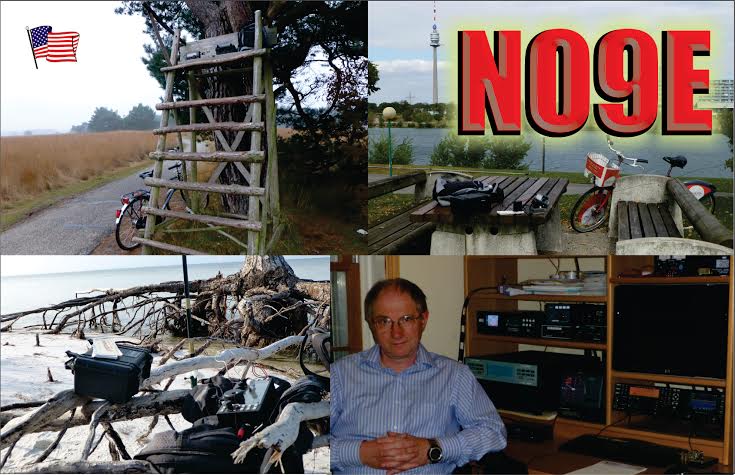
First licensed as SP8FWB in 1972. Built a couple of rigs starting with a tube SSB tx/rx in 1972. The last rig built in 1976 had diode mixers, 2 quartz filters, VOX and RF speech processing. Member of SP-DX Club. NO9E since 1986. Also operated as VK2ISF, CX/NO9E, PY2/NO9E, KP2/NO9E, TA/NO9E,. Stationary setup: K3 with Ten Tec Centurion amplifier, 2-el 5-band quad, 80m dipole fed by a ladderline (for 80m-30m). Also W9INN dipole for 160/80/40/30 + plus a few verticals. On 160m, inverted L about 30m high with 8 elevated radials. Mobile setup: IC7000 + ATAS-100 with 3-magnet mount. Portable setup: IC7000 + MFJ 4125 PS + Daiwa manul tuner or LDG Z11PRO + coax jumper with toroids + spool of 26 Ga (.4 mm) wire + slingshot -- a total of 20 lb. Another portable setup: K2 with internal Li-ion battery and internal tuner, same wire. My quad is made by Cubex and has a constant 8 ft separation. I spent a lot of time trying to tune it, and initially, it was a lesson in frustration. Changing the driven-element affects SWR but less the frequency of the lowest SWR. Changing the reflector size changes the frequency of the lowest SWR. The higher difference in size between the reflector and driven element (to a point), the higher the feed impedance and bandwidth. When all bands were fed together via a balun the quad had poor performance on 10-12 m, and the bandwidth on 20m was narrow. With each band fed separately by 1/4 coax sections and a switch the performance on 10-12m was restored. Feeding 20m by a gamma match widened the bandwidth. To avoid tuning pains, I suggest following a 1992 (?) QST article that is also replicated in the ARRL Handbook. Last modified: 2011-01-22 04:45:39, 1725 bytes cached
My Friends
Does this page contain inappropriate content? If so, Report this page... |
|||||||||||||||||||||