It's May and getting greener! QRV in Oregon - Carpenterville,Oregon (between Brookings and Gold Beach, high above the great Pacific reflector). QRT in Seattle!
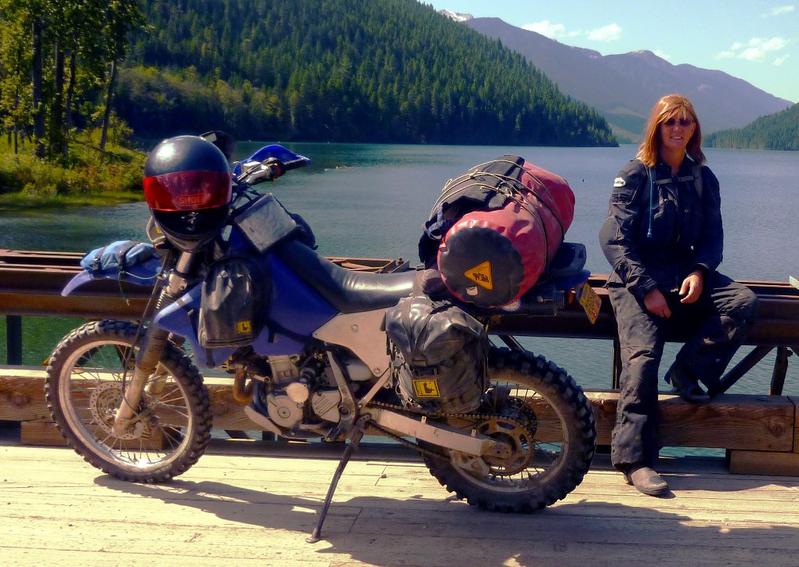
Hi There, my nam My other activity is Adventure Motorcycling. I like to pack up my bike with full self support and head out for a few weeks at a time. At this time I have 4 bikes. My favorite is a go anywhere with full gear dual sport called a DRZ400. I've traveled north to Alaska and South to Mexico on that bike. I also spent 4 weeks riding in ZL land a few years ago and 10 days in TI land. I purchased a K1 Elecraft to pack with me so I hope to chat with you QRP in some remote spot. What am I doing now? QRPTTF/SOTA: Activated OR/SC-184 for its first time! This was my shake down trip with my KX3. I had tested out various 20 EDZ designs that would be light enough to be supported by the 10 meter fishing pole I was using as a center support. I finally settled on #26 poly wire and home brew #26 bare tinned wire set up as open wire using 3/4 spacers made from electric wireing staples. I successfuly tested the setup on the morning of the QRPTTF contest and then packed up my gear and headed to the summit. It was a bright, hot, sunny day overlooking the pacific ocean and the antenna raising went quickly. I was on the air for 1.5 hours and made 14 contacts, one was as far away as CT (I was only running 5 watts into a wire!). All and all, the shake down went well. I still need to work out a comfortable operating postion as it definitely was cause for going QRT. The final setup was a KX3 with KX3 paddles, a 20 meter EDZ with the center at about 25 feet on top of a telescoping carbon fiber fishing pole, a 4200AH LiFe battery pack, a ground cloth, water, snacks and lots and lots of ants. For those condidering the KX3 paddles, my experience was not good. The paddles were prone to dropping dits and dahs meaning the key contact surfaces were failing. It was very frustrating. In searching the web, I found that this is a known problem and that there is no real solution other then attempting to clean the contact surfaces. I am investigating the Begali adventure key. KX3, perhaps you have heard of Elecrafts new ultra portable ultra powerful rig? I've just finished building serial number 3847. This will definitely up my remote QRP hike-a-bike trips. Washington and Oregon SOTA have defined the minimum physical summit approach that allows me to take my dirt bike as far in to the back country as possible while still leaving a modest summit climb. I'm ready to combine my three favorite activities: Motorcycling, hiking and Ham Radio! January, February I'm on my mountain top enjoying the winter 'intermission' we get here in Oregon. Air temps have been in the 50's and 60's. Days have been sunny. The sun decks have reached into the upper 70's so I'm getting plenty of vitamin 'D'! I managed to string up a 160 meter dipole with the center on top of the tower so I could have a respectable signal in the 160 contests. I managed the ARRL 160 cw contest in December and he CQWW160 contest in January. I managed to WAS all 50 states! Now getting ready for ARRL DX. I've revisited my keyer and added Winkey command support. My logging/pan-adapter pc was just getting to bogged down to send CW during contests, so I moved that task to my keyer. I now have limited Winkey support for N1MM and DX-LAB. So nice to have clean CW again, AND it matches my paddle keying! A breif review of the keyer: First built my arduino keyer in fall2009 using an Arduiono board. What is unique is I used freeRTOS, a real time operating system on this tiny board. It made for a very clean speration of keyer functions and controls (speed, dah weight, fist weight, pre ptt delay, post ptt delay, farnsworth) from actually reading the paddle conditions. Now, I've added a Winkey buffer management task and have supported enough Winkey commands to satisfy contesting and typical logging. I'm _very_ happy with the results! So, the tower is finally being loaded on 75/80 meters. I built up a box with two vacuum variable capacitors, mounted it to the base of the tower and attached a 30 ft shunt. One capacitor is used to load the shunt adjusted for 75 meters and the second can be added to ground and tuned for the bottom of 80 meters. I currently have 10 radials. The plan is for 24. I didn't quite get the tower shunt running for the past contest season but dx chasing results look promising. The 160 meter shunt is still pending. CU on the Air! November, December: Lots of contesting! I managed to get time in on CQWWSSB, SSCW, SSSSB, CQWWCW and, with my new 160 inverted V I got time into ARRL160!. The two months of contesting was not without problems. I've made somewhere around 10 trips up and down the tower dealing rotor issues. My trusty Ham IV (rebuilt by Norm) failed on the second day of the first contest (CQWWSSB) pointing at Africa. The good news is that I got most of the contest with the rotor running and I was forced to search for mults on 15 (I ran single band). The bad news is that I needed to come up with a replacement rotor fast. I went to Ebay (against my better judgement) and purchased a TX2 from 'ham_stuff'. When I got the rotor, I wired it up and tested on the bench. It just didn't sound right as it seemed to be straining without load. I arranged for a ground team and did the rotor installation. Unfortunatly, the rotor could barely turn my mast and LPDA. Since my Ham IV had no problem, I have to assume I got a non working rotor from this ebayer. He has offered to replace the motor if I send it back to hom ($50 shipping) but I have already shipped ot my Ham IV to be rebuilt. I also have very serious doubts about 'ham_stuff' as I believe this rotor did not have its original parts but was a 'reclaim' from other rotor parts. I've asked that 'ham_stuff' either 'help' me with a rebuild at Norm's or take the rotor back for a full refund as I really don't know what I will get from this guy. Highly recommend that you avoid the 'ham_stuff' ebayer unless you are getting a 'tech special' price. Meanwhile, I am limping along with this rotor that can barely rotate my LPDA. All that said, 'Ham Stuff" did make good. I requested a partial refund to bring the rotor 'in line' with a tech special and he gave me the refund. I'll still need to have it rebuit by Norm but I now have funds to help do the rebuild. Other stuff I have done on the tower/rotor: moved the startup capacitor from the control box to the top of the tower. This frees up two #18 wires that I use to 'double up' on the direction drive lines from the rotor to the control box. I've also installed a 'boost' transformer in the control box to increase the 24VAC supply voltage to 30VAC as I probably have a significant drop from rotor to control box (350 feet). Neither of these changes affected the rotor performance. :-( Stay tuned August/September
August 2012 For a ham, there is nothing like the sound of clean white noise on an open frequency. After a month bout with 30dBm of 60Hz arcing RFI, it was a pleasant return to clear spectrum (see RFI write up below). The RFI was caused by broken lightning arrestor systems on the transmission lines that feed the city of Brookings. I isolated the RFI and reported it to the power company. It took 1 month for the power company to remove the damaged arrester systems. I was quite pleased with the power companies response. This was not your typical local distribution line that is easily repaired. Shutting down lines that feed an entire community is a tricky propostion. A big THANK YOU to Matt (WB7ESA) and CCEC for their great support.
July 2012
The three most dreaded letters in the Ham Radio alphabet: RFI. A ham could be accused of it or a victim of it. Either way it becomes an immediate challenge to the operation of a ham station. And so my RFI saga begins. Fortunately, I am a victim. When I first moved into my Carpenterville home I did an RFI inventory. The house has several emitters but they are easily controlled (washing machine, hot tub, 12 volt lighting). When these are quiet (which is most of the time because I don't turn them on while I'm operating!) I can hear a pin drop from the other side of the world if the band is open. Towards the end of last year I began getting intermittent interference which I quickly determined was not in my house. The nearest homes are a quarter mile a way so it was unlikey that my neighbors were causing the interference. Fortunately, it would only last a few minutes at a time then go away. As we got deeper into the Fall, the RFI began getting more consistent. I began suspecting the power lines. The RFI seemed to be present during the day, then abruptly stopped in the evening. As the rainy season began, the RFI stopped entirely. I thought my problem was solved.
So, I asked myself, why would a broken lead wire to an arrester cause RFI? It turns out most modern transmission line arresters are made of metal oxide devices. Basically a stack of zinc oxide cylinders designed to show a very low resistance when a very high voltage occurs (like a lightning strike). What I found was these MODs have a continuous leakage current of 100ua to 1ma. Doesn't sound like much until you put 115KVA behind that current! It turns out there is between 10 and 100 watts of power being dissipated by these arresters. Plenty of power to generate sparks if a proper lead wire is not present. Enter the metal chain. Sparking can occur across any metal to metal boundary that is not mechanically tight. This is due to weathering. oxidization and, in the case of this location, salts that build up between
So, do I have a smoking gun? Not yet. I have not heard (with my ultrasonic ear) or seen (arcing) on any of the afore mentioned chains. I'm hoping that the maintenance the should be done to replace the broken lead wires will have a positive effect on my RFI problem. Stay tuned.
Udate 20120731: Matt from the power company emailed and let me know that a crew would be going to the pole to disconnect the arresters. Keeping my fingers crossed.
June 2012 Field Day! I spent a lovely rainy, snowy, cold, sunny warm weekend with CODXC gang running 2A from K7LE. The FD angel was on our side. It snowed as we congregated at the snow park west of Bend, OR. As we began to set up, the sun burst out, melted what little snow we had and got warm enough to take off the fleece!. By 11:00 we were up and running. The rains came, then sleet, then snow, then sun! Fortunately there was no wind! We had a great field day breaking all previous CODXC records :-)
May 2012 Moab enduro and dirt biking was great! 40 meters with an inverted V off the 25 foot mast worked like a champ (better then my dipole in Seattle). Was not happy with the Buddipole. I found that the Buddipole directions for each band are next to useless and attempting to tune the antenna with the telescopic ends adhoc was useless. I was very surprised that the coils (red and black) were not identical. That meant the antenna leg lengths had to be different. I could not get an swr less then 5:1 on 40,30 or 20. I did not try lower bands as they were closed. One thing I know about loaded dipoles, which is what the buddipole is, they have a very sharp resonance and if not tuned properly, you lose most of your power in the feed line and autotuner. I built an 80 meter loaded dipole (half size) resonant at 3.530 MHz and it works really good near the resonant frequency but is useless when I'm so far off resonance that the swr gets above 3:1. When I have a chance I will spec out my two buddipole coils and their taps. Then I will use K7MEM design tool athttp://www.k7mem.com/Electronic_Notebook/antennas/shortant.htmlto determine the actual lengths for specific frequencies I like to operate. So, the jury is still out on the buddipole. I Powered my lighting and radio with a flexible solar panel (rolled out on the van roof). That and a charge controller hooked into the van's battery works great!. Also picked up a Buddipole and 25 foot telescoping mast (really, one of those aluminum flag pole masts with a foot that I can roll my van onto). I tried out the whole setup with my K1 and my first contact was W3ST/KH0. Hmmm time to get a KX3?
April 2012: Added a Tokyo High Power solid state amp to the station. Just in time for WPX SSB! To my surprise, In last years WPX CW contest, I came in "first place" in 'K7" land for a station running low power, a single wire and tri bander. I didnt have my LPDA yet so I was just running a wire! This year I won't be competivie but will be QRV from Utah running QRP. March 2012: I finished re-building my Seattle dipoles. Now have three. The 80 meter loaded dipole, a full size 40 and a full size 20 meter dipole. All cut for the CW section of the band and working well. My Seattle house still generates a lot of 40 meter noise, especially when the furnace cuts in but 80 and and 20 seem pretty clean. Great fun for local QSOs! February 2012: K3 is kaput! Yes, that's what I said. My K3 died while tuning up on 160. No more power out. Zero, nada. The failure is on the LPA card which is the 'Low Power Amplifier' board that drives the PA. If you are familiar with the inards of the K3, the LPA is mounted on the RF board and is flush with the RF board. There are three transistors that are heat sunk to the bottom plate of the chassis. The LPA is exposed directly to your antenna when you lower your power out to below 12 watts and you have your tuner off. You can hear the relays click to take the 100 watt PA out. BE CAREFUL. The LPA does not have the same protection as the 100 watt PA. I made the mistake of lowering my power out so that I could look at the antenna SWR thinking I was being safe but I got into an unsafe mode with the LPA as I was at the upper end of the LPA when something bad happened. So far I've diagnosed that the D1 (S1M) diode is not functioning as a diode. I don't see any marks on it so I suspect a high voltage breakdown. I will be purchasing a new LPA board ($200 plus) and will likely also get this one repaired to have a spare and find out what else may have blown. Kaput UPDATE1: I replaced the LPA board ($211 plus shipping) and my K3 is running again. I've sent in my bad LPA card for repair. Still thinking it is just the diode. Will hear back from Elecraft in a couple of weeks. Kaput UPDATE2 It was indeed the D1 diode on the LPA card. An easy fix if you have a needle style soldering iron and some good needle nose pliers. the component costs less then a few cents but you have to buy the my the thousands. I'll be looking for through hole equivalant form the 'Shack". The lesson learned here is: Be very careful when exposing your K3 to an antenna that may have high swr when running the K3 at power levels lower then 12 watts. I'm not even sure if running at 2 watts is safe. It may actually be safer to run the K3 at 15 watts, where the 100 watt PA kicks in and rely on the better protection available in the 100 watt PA. BTW, the SWR is 6:1 on my 160 antenna (I'm working on it) and I really didn't expect to blow something up at that swr but I do know that some transistor amps can be vulnerable and I seem to have found one in the K3. 160 In an attempt to get on 160 for the CQ160 contest I put a half sloper off the top of my tower. Best SWR I could get was 6:1 (see above note on high swrs with the K3 at low power) The tuner in my K3 and my 756ProIII are able to hande this but I was clearlly heating up coax (or tuner). It has good ears but couldn't be heard by anyone who was less then 10 over S9 at this QTH. I've been laying out radials which has little effect on the sloper so I will be building a shunt feed later this spring. January 2012 Built up the LPPan pre-amp and installed into my LPPan. I can now see the weak signals that I could hear!. Started making K9YC baluns using Fair rite 2631803802 2.4" O.D. #31 ferrite cores. I'm building up a 160M balun and an 80 balun based on the K9YC design with some mods for supporting balun added by yours truely. (see great write up by K9YC here) The plan is for a couple of half slopers off the tower (160 and 80).
October 2011 Added the Idiom Press contoller board to my Ham 4 rotator controller. Point and shoot has a whole new meaing! I have to say, I was a little concerned when I started tearing into the stock controller. The directions required pulling a lot of wires and boards from the existing controller and if it didn't work I would be stuck with the LPD pointing to EU!. The Idiom Press directions for the Rotor EZ kit was very good and in a few hours I had it up and running. Although I can think of several useful enhancements, I am quite happy with the functionality.
July 2011
Got on 17 meters Friday night and worked the world! Great opening just as I finished up the cables to the house :-) The ham radio universe was smiling for me!! Now, for my next project. Tower project status: Going up! 5 sections in the air. Paul Nyland and team from Custom Metal Works have done a great job putting together this self supporting tower and getting it installed on my knife edge ridge! If you have a challenging site, then Paul is your 'tower guy'!
Building t
May 2011
The M2 7+10-30 Log is here and waiting to go up on the tower. Rotor and coax cable has arrived. Waiting to get my rotator back from Norm's rotator service soon. Norm shipped it in 30 days plus 3. Not bad for an estimated 30 day turn around.
read this if you are a biker) My Ducky is back! I brought my Ducati down from Seattle and just put it back on the road. I live way up on a mountain top here between Brookings and Gold Beach on the old RT 101 which is 20 miles of twisties. I never thought I would have such a great bike road a mere few hundred feet from where I live! Guess I'll get those 'chicken stripes' worn off pretty fast. Anyway, that lovely Ducati rumble can be heard in these mountains.
March 2011 Began planning my Carpenterville tower project. Site contractor is set, working with tower contractor and making final decisions on the antenna. Leaning towards a log periodic with a 7 MHz element. February 2011 Added the second receiver to to my K3 and additional filters cw (1KHz) November 2010 Working on extensions to quisk that will allow me to set the K3 VFO B for split operations. First version is very promissing! Broke several PJ pileups by watching the panadapter and clicking on a split frequency where I thought the operator was listening.
October 2010 Built up an LP-Pan and using Quisk as my linux based panadapter. This needed some software mods to work with the latest kits being shipped by Telepost. It turns out the IF crystal shipped with the new units for K3 are not at the K3 center IF frequency which causes some frequency display problems with quisk. Getting this running was not for the faint of heart. The signal chain is very long and I had to verify that every part was working before I discovered that there were some configuration and software issues. All working now and I had the added benifit of becoming a python programmer! Ran CQP with the central Oregon DX club. Call sign is N6M and we are located in Modoc county (MODO). On top of Timber Mnt at the Modoc National Forest lookout. Very HOT here! Sept 30, 2010 I'm getting the LP-PAN adapter going for the K3. It has been quite the experience. Not recommended for appliance operators! More to come! Aug 28, 2010 recouperating in Carpenterville. Sadly, the bands died while I was on my trip. I did manage an average of 8 Q's per location but signals were weak by the end of the week even at prime alpine lake locations. Aug 22, 2010 Heading south in OR on rt 395. Spent two days in Hells Canyon mostly nasty unmaintained dirt roads. Rt 39 south of Joseph was closed due to a washout so the adventurous that have the right equipment go down Hess road FS390 I think) Made a bunch of QSOs with the K1 and either a delta loop or a 78ft doublet. Found a nice un marked camp ground at Hells Canyon Lookout. Down hill in all directions from about 6,000 feet. Nice spot for QRP. I've been able to get the wire up at about 40 feet with the tennis ball slingshot. I need a bit more practice but better then the armstrong method for which I'm lucky to get 15 feet! Heading south :-) Portable from 8/19 to 8/25 operation thru the NorthWest was 6 days, 34 Qs, 6 antenna settups, three dipoles and three delta loops. Used a water baloon slingshot and a weighted tennis ball to get the wire up to as high as 60 feet. Elevations ranged from 354 feet to 6,700 feet. Best location was at Hells Canyon Overlook at 6,000 feet. Solar conditions deteriorated through the week but was still able to wrk the east coast at the final two locations. I had a great time and thanks to all for working my QRP station! Aug 11, 2010 I've fired up the K1 and am outfitting my K1 station for a Ham radio motorcycle trip south through the Washington/Oregon/California Cascades and into the Sierra's. This will be a six day trip and I hope to be QRV every evening after 5:00pm. I've put together a versitile wire antenna system. It can be hung as a full wave delta loop for 20 or a 75 foot doublet or a 37 ft wire vertical with two 37 foot radials. All configurations are fed with 450 ohm coax. I have a 2000mA hour 12 volt sealed lead acid battery (camcorder battery) which conveniently charges from my motorcycle electric system I really like my tennis ball canon but it is not portable enough for this operation sooo, I'v orderd up a water balloon sling shot called the stream machine solo water balloon sling shot that works really well with my weighted tennis ball and packs away nicely in my motorcycle luggage I can get 50 to 75 feet easily and it is very portable!
Aug 6, 2010 Ran the low power NAQP CW contest all bands. 332 Q's in 10 hours. Made good numbers on 80,40,20 and 15. Just didn't have the signal for 160 and nothing heard on 10. 36K + points. Not bad for a first serious contest attempt with just wires. July 31, 2010 Hooked up the K3 to the two EDZ's in Carpenterville. Wow what fun! the KH6's were pounding in 20 db over s9. With the two EDZ's hooked up to the K3 on ant 1 and ant2 it is very easy to find which one is favoring the incomming signal. The real bonus is that the K3 remembers the ATU settings for each antenna on each band! Did I mention I was having fun! July 23, 2010 Drake L4B is running fine! I will be putting Carpenterville QRO next time I'm back there. Of course I will need a bit more power then my little K1 can produce. To take care of that little problem I built a K3! It took about 7 hours to build. 2 hours were spend just sorting all the screws, washers, standoffs and nuts. The rest was pretty smooth. A couple of minor issues with the inventory pages (part numbers not matching) but otherwise went together very smoothly. Now up and running in Seattle. July 3, 2010 The Drake L4B was packed well but the power supply had dented foot plate due to the weight and a likely 40 inch drop by Fedex in their automated shipping center. I banged the plate out and decided to bring it back to Seattle with me to test at K1NVY's rf lab before I put full 220 on it. Ordered a K3 which I am having delivered to Seattle and will build in Seattle before taking it down to Oregon. Played in the IARU contest for a few hours QRP from Carpenterville. 70Qs in 4 hours, Search and Pounce mode only. Got on 40, 20 and 15. Great fun and wished I could have done the full 24 hours. June 26, 2010 Field Day was a blast! N7LE operated two stations, one SSB and one CW on 80 through 6. We got three wires up into trees using my tennis ball launcher. The trees were nearly 100 feet high but the launcher had no problems clearing the tops and laying a line at the highest branches. Serious fun! June 12, 2010 Waiting for some parts (Drake L4B, powersupply and big rig) to upgrade the station in Oregon. Should see that come together over the next few weeks. Planned antenna adjustments include: getting the center of the east/west EDZ up another 20 feet. Improve one of my 1 to 1 baluns. May 1, 2010 So, I like the EDZ and coax balun I built so much, I'm building a second EDZ and have completed my second balun. The next EDZ will be mounted east/west, sloping on each side. I'm hoping for a good omni directional pattern with very low angles to the north and south as well as higher angles of the sloping dipoles to the east and west. On May 4, I took my balun over to K1NVY and we used his RF lab to see how it performed. Quite nicely actually. It matched the April QST article specs for swr almost exactly. We ran a few more tests and determined that below 4MHz the balun seems to have some lumped inductance (which is why the swr rises). Quite fun, using a phase and amplitude instrument and a vector scope with a sweep generator. We verified these results with an MFJ259b, which, by the way, does everthing the rf lab does except for the sweep scope. Finished up the K1 2 band board, tuned it up and have been using it for my 80 meter rig. Scott, down at Elecraft was very helpful and getting me my missing parts and clarifying the location of a component that was shown on my older K1 RF board. April 16, 2010: Putting up an extended double Zepp in Carpentervillle / Brooking. I'm using 450 ohm ladder line, a simple dog bone insulator with tieraps supporting the ladder line, 4 to 1 balun made up of LMR400 coax, update 20100417: wx conditions on this mountain are variable. I managed to get one leg up, If conditions improve I'll get the other leg up today. update 20100418: The EDZ is up. Oreinted north/south with a slight slope to the south. Noise level is very low, lots of dx, loads up on the four bands I currently have on my k1. Thinking about putting a second one up oriented east west. ( the tennis ball launcher put the line up right at the top branch of the trees! March 9 Carpenterville, OR QTH is QRV! At 1,750 feet above the Pacific (the shack has amazing Pacific ocean views) with 360 degree views and long horizon shots and 15 miles north of the California border. Went QRV with the K1 on Feb 1 QRV motorcycle trip. My trip to SF and up the coast was success _and_ an adventure. I made 16 QRP contacts ranging from across SF bay to across the Pacific, continent and Atlantic all on a random long wire. Ive decided to be a bit more scientific about my long wire next time, Maybe cut it for an W3EDP long wire. You can see my blog posts about the trip here. What are my Ham Radio projects Current projects include: AG-Iambic keyer using the Arduino board and a real time operating system (freeRTOS) to allow for unlimited feature addition. Current bread board: Put together an alpha version of the AG Iambic keyer. A nice little board mounted on top of the Arduino board. Much cleaner and ready for the little box I'm preparing. Just need to cut the holes. I just completed a software change to my AG Iambic keyer so that I can hold the dah paddle down for 8 dahs and the keyer will hold the key down solid so that I can tune a mat AG-Iamabic Update: I've added a driver for a 'send' signal with pre key and hang delay to turn on xmit on the xciever before the exciter hits the amplifier. Saves on the amps input relay and the finals in the exciter. To accomadate the additional tuning of the delays, I've change one of the pots to an optical encoder that has a push button on the dial. Now I can toggle through what the encoder is connected to and tune the dah spacing or pre delay or hang time for the keyer. Coding the encoder for an RTOS operating system was very fun! I put in a fist delay control that is one of the optical encoder delays. It allows me to control when the active paddle will be sampled and latched after the detection of the active paddle release. I found it to be quite sensitive to my fist and have it set to a full element plus 25% (adjustable from 1% to 200% of the element). I current have the opposite paddle set to be detected immediately after the active paddle is hit which seems to work fine, except for the occassion paddle key bounce. Still looking for someone who has a state diagram of Mode A and Mode B. Anyone reading this who has such a drawing, I would love to take a peak at it . Meanwhile, what counts is if the keyer feels comfortable and I must say, tweaks have allowed me to tune the keyer into my fist very nicely. AG-Iambic update: boxed the AG Iambic Keyer up, some finishing touches needed for labeling.
I'm doing some back engineering to fill in some instrumentation for the keyer RTOS. Once I've completed that, and have a good picture of how the compute resources in the keyer arr being used I will implement a subset of the Winkey command set to better integrate into my station. It works great as is, so I'm dropping the priority and spending some time playing with RTOS instrumenttion on the Arduino board.
Arduino freeRTOS based swr analyzer. VFO built and ready. lots of TBD. Completed (or stable) projects: 80 and 160 two band board for the K1. Got all the parts, just waiting for me to allocate some time for kit building. update 20100410: assembled the board and found three parts missing. Elecraft is sending them out but not in time for my next trip to Oregon. Will have to wait until my May trip. update 20100503: Completed, tuned and QRV Retrofitting an AL80A with decent VHF suppression (and getting it back on the air) DONE (with the help of AG6K's kit and K1NVY's bench! QRO again :-) Tennis ball pneumatic antenna line launcher: Got the CSV17 launcher kit from here. So far, the kit looks pretty good. Some screws were missing from Update 2010025: Completed the assembly of the launcher. Preliminary air pressure tests are positive. First tennis ball launch next week! I modified some of the component orientation more to my liking Cant wait to put up a dipole at my new place!. Update 20100416: Did some pre launch testing with fishing line and tennis ball. Works awesum! Uped the anti and started placing the extended double Zepp in the sky. It was a little breezy and I quickly figure out that the launcher could easily fly over my intended target, but the wind would take the trailing line and blow it where ever it liked. I did manage to get a line within four feet of the maximum hieght I wanted so I'll move on from there. 73 es gd dx! Hope to meet you on the air! Notes on eQsl: I have stopped maintaining eQsl and will be deleting my eQsl account. This has proven to be far more trouble then it is worth. Why? I have two main QTH's. eQsl REQUIRES that I start a new log each time I move from one QTH to the next and back again. This is highly time consuming and complicates updating to the eQSL because I have to keep track of dozesn of logs over the past few years and manually configure my eQsl uploads to the proper log. I have made many mistakes in attempting to do this which causes even more problems. I have spent dozens of hours just correcting my own mistakes instead of operating or getting QSL's to people. I'm done. fini. no more. LOTW has a much better system. You have a tag for a particular QTH. It does not care when you were there. I simply upload to the QTH I am at and I am done. No mistakes, no trying to remember which log that qsl was in. I have contacted eQsl a number of times on this issue and have gotten very short responses indicating that they don't see this as a problem because most people only have one QTH. Well, fine, I'm not going to use your servce then. I'm a Big Data person. I have been dealing with very large data sets for dozens of years. I've been in this industry for over 40 years. This not complicated but apparently it is to complex for the eQsl team to figure out. btw,
Those who are willing to exchange freedom for security deserve neither Ben Franklin
Last modified: 2013-05-01 05:22:22, 45594 bytes cached
This user has no active logs
Does this page contain inappropriate content? If so, Report this page... |
|||||||||||