NO QSL VIA BUREAU *** NO QSL VIA BUREAU *** NO QSL VIA BUREAU *** NO QSL VIA BUREAU *** NO QSL VIA BUREAU *** NO QSL VIA BUREAU 10-10 # 76195 This is how I process QSL-cards for PH9HB: NO cards via BUREAU please! >>> ONLY DIRECT QSL cards will be answered! Each band/mode will be confirmed only once! cards received directly with s.a.e. and 2 USD = confirmed directly cards received directly with IRC = confirmed via bureau cards received directly without USD = confirmed via bureau cards received without envelope = confirmed via bureau PLEASE NOTE: cards for PH9HB received via bureau will NOT be processed at all cards with missing or wrong data will not be confirmed. PH9HB prefers electronic QSL via eqsl.cc or LoTW >>> saves time and trees! Please note that ALL e-qsl's for the aeronautical mobile QSO's must be sent to PH9HB/AM Unfortunately Logbook of The World (LoTW) cannot be used for my air mobile QSO's! Because:
LoTW serves awards and uses the confirmed QSOs as credit toward awards.
Contacts with aeronautical mobiles do not count for VUCC (Rule 4d) nor for DXCC (rule 8) therefore uploading my QSOs is not useful to LoTW users.
If you really need a paper QSL-card, you can print my card yourself from www.hrdlog.net! If you do not want to print my card yourself, you may send your card with a Self Addressed Envelope and 2 USD to my home address. NO IRC's PLEASE and do NOT send me SASE with other than dutch stamps. I manage all QSL cards for our contest team PA6NH. Please read and comply with the given QSL rules on QRZ.com/PA6NH Nederlandse stations kunnen een gefrankeerde, aan zich zelf geadresseerde envelop bijsluiten. In dat geval hoeft daar uiteraard niet nog eens 2 USD bij. Due to the volume of cards received, they will only be answered directly if sent with sufficient funds AND SAE. Cards with IRC's will go via the bureau, because our local post office does not accept them.! What I like most about HAM-radio: you can still find the good old HAM-spirit with some operators, unfortunately they are getting very rare. Some operators appear not to be familiar with the DX code of conduct. For those interested click on the logo/image at the top of this page!
I guess it's a general thing nowadays that people DO NOT LISTEN before they start talking. To me, this is very poor operators-practice. Follow me on www.TWITTER.com/PH9HB to see my schedule for upcoming flights as PH9HB/am
I am a founding member and QSL-manager of the PA6NH contest team And now some information about myself: Born and raised in Switzerland, my first encounter with HAM-radio was as a 12 year old boyscout during a Jamboree On The Air (JOTA), where scouting groups from allover the world meet on the HAM-bands. I was fascinated by the combination of technique and languages. Communicating with other people all over the world is what I still find very interesting.I have a big passion for languages. I passed my HAM-exam back in 1985 at the age of 19. My first call sign was HB9SJL.
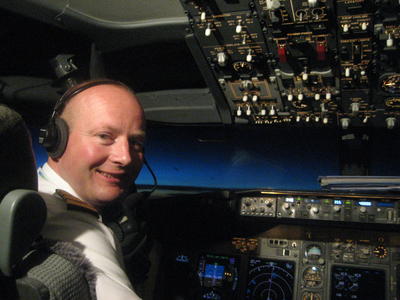
Two years later I chose to become a pilot. Yet again a fascinating hobby where a combination of technique and good airman ship can make your day. I can play with high-tech equipment, work on the HF HAM-bands and even get paid for it. After having flown the rich and famous on business jets for over 10 years, I now fly Boeing 737 NG (-700 and -800) for a Dutch carrier based at Amsterdam-Schiphol. As PH9HB/am, I have worked some interesting DX stations. I usually stay around 14.165 MHz (primary) 14.325 MHz (secondary) or 18.165 MHz and sometimes USB channel 7.185 MHz +/- QRM. The onboard equipment consists of a Collins HFS900D (USB and AM only!) with 400 W PEP and a fully automatic antenna-coupler/tuner. The antenna is of the shunt-fed slotted type, situated on the leading edge of the vertical fin on the tail section (see picture below: slot on bottom end). For those of you who are interested in more info on this type of antenna, please try this link:http://www.patentstorm.us/patents/7511674/fulltext.html
From the end of 1987, I was inactive on the HAM-bands until I applied for a dutch call-sign in July 2008. My Swiss (F) license was good enough to get myself registered in the Netherlands. Because of my (Swiss) past, I chose a combination of HB9 and PH. PH is the prefix for all dutch registered aircraft. This resulted in a rather unique combination: PH9HB
We live 1m/3 ft below sea level in the north-western part of the Netherlands, in a small town called Opperdoes, located 3 km west of Medemblik, 15 km north of Hoorn, and approx.50 km north of Amsterdam. We have a fairly large garden (for dutchies) so I have enough space for antenna's.
At home I use a FT-950/100 W PEP with a MD-100 dynamic desktop-mike and a square shaped 80 m horizontal loop at 10 m / 30 ft. above ground, supported by four trees. With a Palstar AT1KP, I tune the loop from 160 m through 6 m without a problem! On Sept. 1st 2010, I added an Italian made 3 element ultra beam (www.ultrabeam.it) on a 13m/40 ft. tower. Thanks for looking me up! vy 73, Jerry.
Last modified: 2012-05-12 09:23:44, 14001 bytes cached
Does this page contain inappropriate content? If so, Report this page... |
|||||||||||