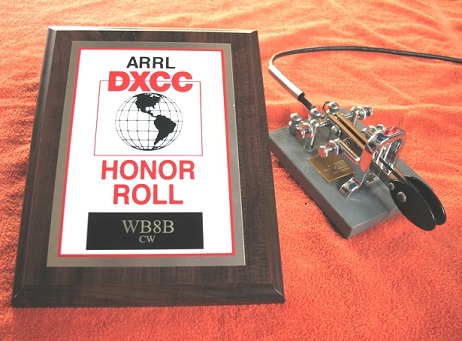
Greetings fellow Amateurs & radio enthusiasts from WB8Bob! MORSE CODE (From never to always): After the agony of listening to Morse code practice tapes starting in 1984, I was finally persuaded to take a Novice class in 1986 and got the license in Jan ’87.By June of '87 my speed was good enough to pass the 13 wpm General Class. The 30m band then became a daily ritual of working CW (Morse code) which contributed to a quickupgrade to the 20wpm Extra class in Sept ’87, (9) months after my Novice. Since then, I've seldom used voice on HF. Learning the Morse is about creating new habits including regular, consistent and repetitive practice. If you put your mind to it and stick with it, you can do it! THE DX BUG (DXing at age 7?): When I was 7, Santa Claus left some 27Mhz Walkie-Talkies under the Christmas tree. I became intrigued in finding out how far I could reach with them. CB SSB radio and short wave listening then supplemented my curiosity into the ‘80s. After passing the Extra Class and working the world on HF, I got hooked. I then began the pursuit of the ARRL DXCC awards on CW which is still my prime interest to this day. DX Awards (The on going chase): Wallpaper includes the following awards:
DXCC COUNTRY TOTALS on CW (worked / confirmed):
I have 1954 “band countries” confirmed on CW, and 2381 worked on CW. Even though the "Challenge" is currently a mixed mode award, we have only CW mode contacts to apply to it. Maybe someday this award will be "mode" selective?? LOW BAND DXING FROM A CITY LOT: (Pulling them out of the weeds!): I’ve been active on 80 & 160m since Dec ’02 with an 18 month intermission in between. Memorable 160m contacts are Australia (VK), Willis Is. (VK9), Japan (JA), New Zealand (ZL), and Asiatic Russia (UA0), along with Mongolia (JT) on 80m CW. The 160m contests have been fun with most 50 states workable at 100w in one contest weekend if conditions are just “average”! I’ve logged all states including HI and AK on 160m and all contacts on 80 & 160m have been with < 200w. 160m has been a challenging band due to the typical high QRN found in a city sub division. 160m from a city suburb can be done, but get used to frustration of hearing stateside comrades working DX that you can’t come close to hearing. Receive antennas on 160m determine who the big guns are. It’s all about signal-to-noise ratios on these bands! QRP DXING ON CW: 169 countries have been logged at 5 watts, and even a few dozen countries at 1 watt (QRPp). A 1w QSO with Japan on 10m was one not to forget! I’ve seldom used an amp and have been without one since 2003. Long path propagation on 40 and 80m deep into Asia is about the only time I wish I had the extra juice. One thing to note to fellow QRPers; the guy you’re trying to work must have the antennas and good operating skills to pick 'your' weak signal out of the weeds. Just remember that there's more work on his end than there is on yours to make a QRP contact. PROPAGATION DICTATES WHEN TO USE AND NOT TO USE QRP! DX PILE UPS (Adrenaline): A good recipe is rare DX on 40, 80 or 160m in the evening. A big massive state side pile-up prevails pinning the S meter to the corner then snowballing to 5-10 kHz of bandwidth. Skill, patience, DX station operator mind reading, and more persistence are needed for busting through a pile-up! For the most part, if we can hear them, we'll log them in at 200w. GIVING A HAND: It's great to help others that have an interest in working the HF bands. There are many facets in this segment of Amateur Radio, and it's rewarding to support others in the understanding of antenna theory, operating techniques, station set up, contesting, propagation, and QSLing. THE DX CLUSTER: Thanks to all of the DX Cluster Sysops for the many years, going back to the PacketCluster days of the 1980’s, for the effort and money they’ve put into the system. These fellow Hams have provided one of the best tools for DXers to use in the pursuit of DX on the bands! PROFESSION: Lead Battery Test Engineer: Test Engineering, Research, Development and Validation of LiION and NiMH battery systems for use in Hybrid Vehicle, Electric Vehicle, and Stationary power battery applications. Testing and data analysis of battery systems and related sub-components. Design of test methods for battery systems state-of-charge (SOC) algorithm development. STATION ANTENNAS:
If you’d’ like to chat, drop us a line. Hope to work you on HF! GL DX 73 de WB8B / Bob
Last modified: 2012-03-03 15:38:04, 12633 bytes fetched
My Friends
Does this page contain inappropriate content? If so, Report this page... |
|||||||||||||||||||||