


to QRZ
Latest Awards




Trials & Errors #70 12/15/25: General Electric and the Alexanderson Kidnapping
It was a cool, Spring morning on April 30, 1923, when three youngsters were outside their Schenectady home playing in the yard. They were the children of an immigrant Swedish family, the Alexandersons, who had moved to the USA so that their father could work for the General Electric company. A quarter of a century before, Thomas Edison had joined forces with financier JP Morgan to merge his company and others into the General Electric Company. Their father, Ernst Alexanderson, was a key part of GE's R&D team doing communications research and had become a well-placed executive scientist.
Perhaps it was because of the publicity generated by his inventions that the Alexanderson residence had become the target of criminals. He may have been perceived as someone who, like Edison, had greatly profited from the "miracle" technologies coming out of the GE Schenectady labs. Of course, this wasn't true, as corporate inventors of that time would see the resulting revenues go to their employer. Despite this, the nice home in Schenectady's General Electric Realty Plot must have looked like a good target.
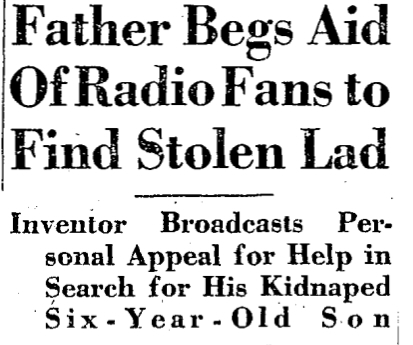 The oldest Alexanderson daughter, Edith (11) told police later that she and her sister Gertrude (7) were playing with their brother, Verner (6), when a man approached them saying that he had too many pet rabbits . . . he told the children that he would be happy to give them a few bunnies and sent the two girls back to get a box.
As the girls left, young Verner was led away. The story of this kidnapping became front page news all over the world, a harbinger of what happened a decade later to Charles Lindbergh and his wife.
Except, this story had a twist when radio became a key element of the solution! The first Amber Alert! (Thanks N1YR)
---
General Electric's Communication R&D Team Strikes Again
I've mentioned in previous columns how I was raised by a General Electric historian. My dad was the keeper of all things Thomas Edison, as presented by GE's publicity department (which tried their best to keep Edison's memory alive with the public). As a result of this indoctrination, I became fascinated with the exploits of the company's innovation team as there have been a number of radio heroes who came out of the early days of the company. One of my favorites is Ernst F.W. Alexanderson. Perhaps it is because my family has roots in Scandinavia as well, but I find his story to be one that typifies the creative spirit and out-of-the-box thinking inherent in our radio history. His inventions were all over the map, from radio and antenna design to electric railroad engines and facsimiles.
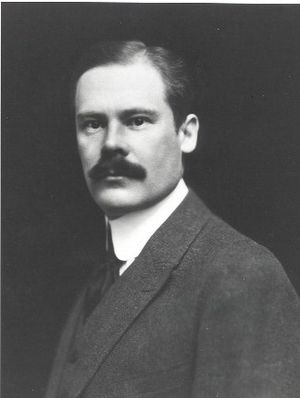 Ernst Alexanderson was just 22 years old when he made an important decision. He studied at both Lund University (where his father taught) and also at the Royal Institute of Technology in Stockholm. He was the kind of young scientist who would spend hours at night reading the latest scientific reports. One of them was a paper published by Dr. Charles Steinmetz (GE's chief engineer) on “Alternating Current Phenomen." This changed Ernst's life, and it was in 1900 that he determined to go to the United States to seek work with Steinmetz. After a short stint with another firm, In 1902 that dream to work for GE came true. And he remained there producing new, patentable work for 46 years with well over 300 US patents (the last one coming when he was in his 90's). This guy was an innovation machine all by himself.
For our area of interest, his accomplishment was to take radio out of the "local" mode and move it to serious long-distance communications capability with the invention of a device that was the predecessor of vacuum tubes. In 1904, Alexanderson and a small team were asked by Steinmetz to build a high-output machine that would produce a unique, "undamped" continuous-wave transmission.
Alexanderson constructed a two-kilowatt, 100,000-cycle machine after two years of experimentation. It was installed in Reginald Fessenden's station at Brant Rock, Massachusetts, and it was there that on Christmas Eve, 1906, the station transmited an historic radio broadcast which included both a voice and a violin solo. (See my last column on Fessenden).
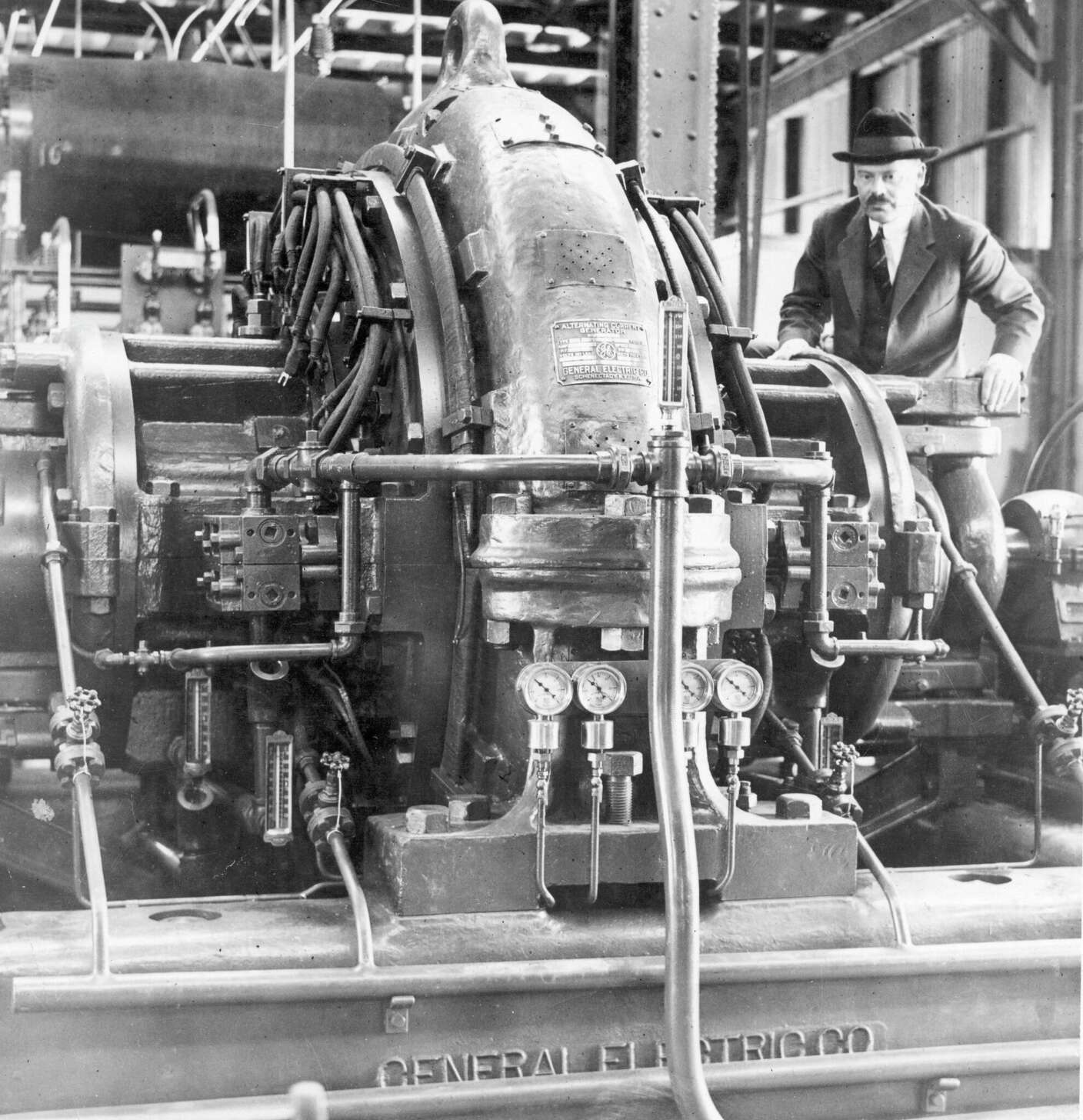 As the years went by, the "Alexanderson Alternator" was seen as the way to transmit signals that were strong enough to be heard around the world. The patents stacked up as Alexanderson and his team developed the technology further, and in 1920 the Royal Telegraph Agency of Sweden sent out an RFP requesting proposals for a state-of-the-art "high powered radiotelegraphy station" to be located in Grimeton, Sweden. This was an ideal coastal location for such a station. The competition included Telefunken (Berlin), RCA (New York), The Marconi Company (London), and the Société Française Radio-Electrique (Paris).
---
The transmitter chosen for this high powered station was a monstrous 200 KW version of RCA's Alexanderson alternator (photo). General Electric had spun out RCA a few years earlier as a subsidiary, and it helped their bid that the Swedish-born designer Alexanderson was a part of the company. However, it was also critical that there were many other stations using this equipment so there would be few compatibility problems.
To clarify, these transmitters consisted of huge, rotating AC generators (the alternator) which were spun by electric motors at a fast enough speed to generate RF. That RF would then be applied to an antenna, and several versions of compatible antennas were also designed and patented by Alexanderson in his role as Chief Engineer of RCA. Alexanderson's alternator was one of the first transmitters to generate undamped continuous waves, which could communicate at a far longer range than the damped waves used by the spark gap transmitters in use a few years earlier. (I believe the fundamental difference lies in how the signal's strength changes over the duration of the transmission: constant and steady for undamped radio waves, and fading for damped waves. Please correct me in the forum discussion if this is not stated correctly).
Can Radio Save Young Verner?
Just one year before the Alexanderson kidnapping, General Electric and its RCA subsidiary built Schenectady's WGY radio station, one of the first commercial stations in the United States. Ernst Alexanderson was responsible for the design and build of this station, one of the most powerful and important of the early stations. And when it came time to spread the word about the kidnapping of his son, Verner, Ernst and his wife devised a plan to use WGY to "get the word out."
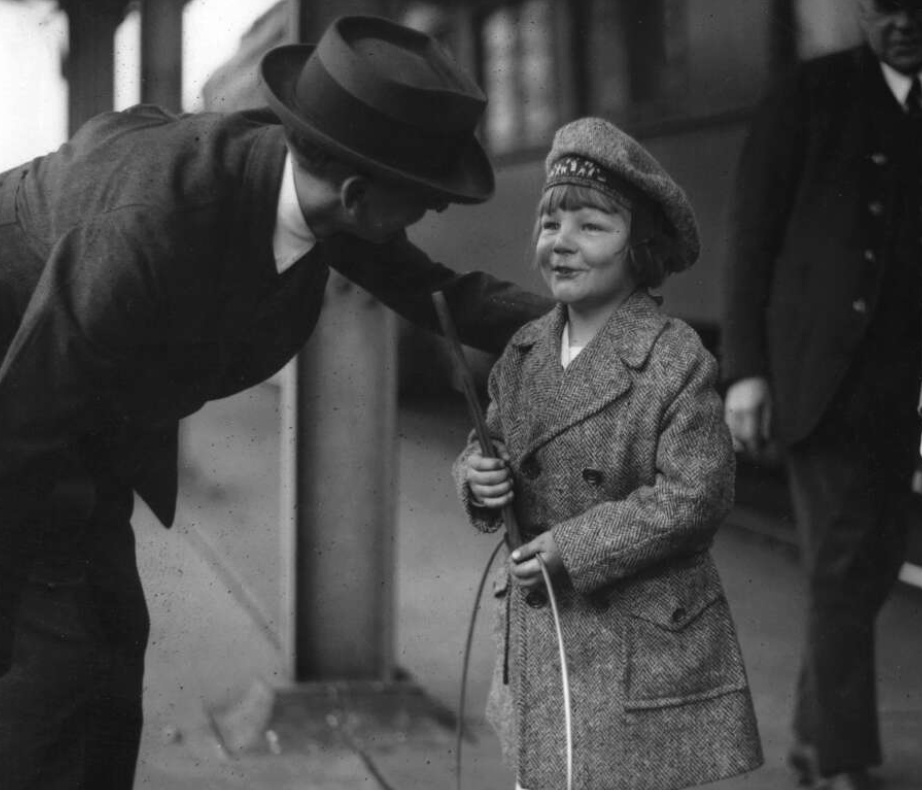 The Alexanderson family blasted the news out repeatedly on WGY. They offered the fascinated public both descriptions of his son as well as descriptions of the two men who had been seen putting Verner into a car and driving away. Rewards moved up with contributions from multiple sources, from $1000 to $5000 (a lot of money at the time). After the first day of regular broadcasts about the kidnapping, a woman telephoned the police that she had heard over her radio set that they were seeking a boy and that she had seen him with the stranger in the city streets about 3:15, an hour after he had left his home. She refused to divulge her name or address and hung up her receiver when the police sought to question her. However, it gave hope to the Alexandersons and the police that the radio could be an excellent tool to let the public assist in a major crime.
The two men responsible had taken Verner to a distant cabin in the woods, and hired a relative to care for him. When they heard the news that everyone in New York and Canada knew their descriptions, they began to worry. A man from Ogdensburg heard the radio reports and told police that he had rented a car to those two men. Stanley Crandall and Harry Fairbanks, scared now that everyone in the area knew of the crime, left Verner and got into a rowboat to travel 22 miles across the St. Lawrence river and into Canada. It was years before they were apprehended but the police were eventually successful.
Young Verner, left alone in the cabin with a dog, was discovered by another radio listener, who came by as a handyman to fix a window and clearly identified the lad. He was home three days later, safe and sound. It was a first for radio -- those broadcasts had saved the day. And it was a kidnapping with a happy ending. In those days, that was rare.
 In Conclusion
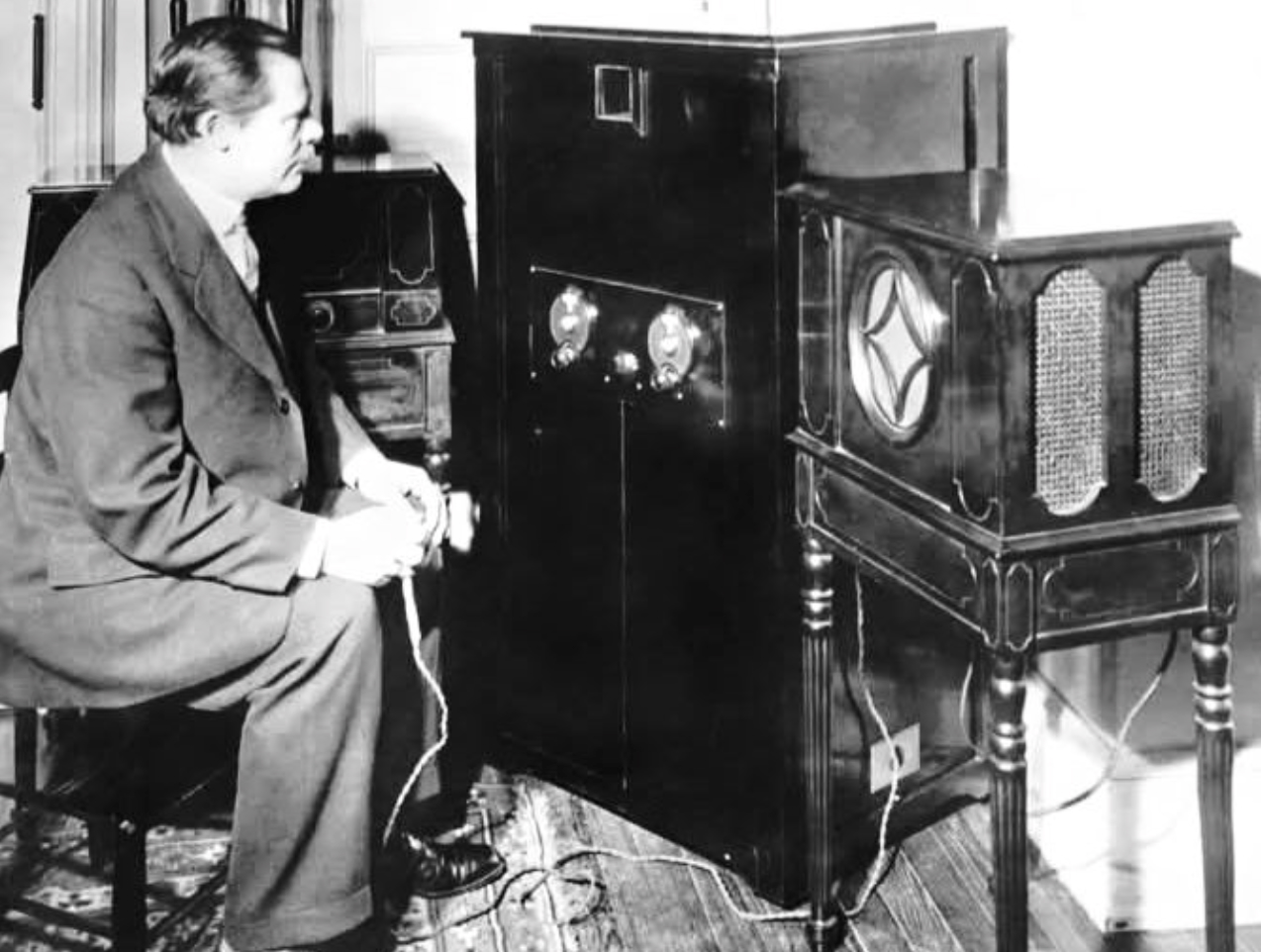
Ernst's story goes beyond his radio exploits. As mentioned above, his developments included inventions that are far from that scope. While Philo Farnsworth is credited with the invention of the system used in modern television, I find it interesting that it was in Alexanderson's home in Schenectady a number of years earlier (1928) when images were sent over the air on a crude, 24-line video signal and seen on a 3-inch screen. Synchronized audio came over WGY.
Hope you'll add some comments to the discussion forum linked below! VY 73, Dave W7DGJ

CLICK HERE and JUMP INTO THE CONVERSATION
|
|
Dave Jensen, W7DGJDave Jensen, W7DGJ, was first licensed in 1966. Originally WN7VDY (and later WA7VDY), Dave operated on 40 and 80 meter CW with a shack that consisted primarily of Heathkit equipment. Dave loved radio so much he went off to college to study broadcasting and came out with a BS in Communications from Ohio University (Athens, OH). He worked his way through a number of audio electronics companies after graduation, including the professional microphone business for Audio-Technica. He was later licensed as W7DGJ out of Scottsdale, Arizona, where he ran an executive recruitment practice (CareerTrax Inc.) for several decades. Jensen has published articles in magazines dealing with science and engineering. His column “Tooling Up” ran for 20 years in the website of the leading science journal, SCIENCE, and his column called “Managing Your Career” continues to be a popular read each month for the Pharmaceutical and Household Products industries in two journals published by Rodman Publishing. |

Articles Written by Dave Jensen, W7DGJ
- Trials & Errors #83 (8/7/26): In Celebration of ARES - Akerberg and the Ohio Floods - August 8, 2026
- Trials & Errors #82 7/23/26: Marius LaTour and the Effects of Quiet Competence - July 22, 2026
- Trials & Errors #81 (7/4/26): Egos and Eagles - 100 Year Anniversary of Norge Expedition - July 4, 2026
- Trials & Errors #80 - Amateur Radio Battles Through Difficulties - June 18, 2026
- Trials & Errors #79: Our Expensive Hobbies - May 31, 2026
- Trials & Errors #78: A Banner Year for Ham Radio - May 11, 2026
- Trials & Errors #77 (04/18/26) - Radio Heroes on the International Pacific Highway - April 20, 2026
- Trials and Errors #76 (3/28/26): Bringing Down the Duke - March 28, 2026
- Trials & Errors #75: On the Air with Zane Grey in Tahiti - March 7, 2026
- Trials & Errors #74 (3/1/26): Marketers, Help Grow Our Small Innovators! - February 21, 2026
- Trials & Errors #73 (Feb 7, 2026): Playing with Radio - February 7, 2026
- Trials & Errors #72 (01/19/25): Greetings from Outer Space - January 20, 2026
- Trials & Errors #71 (01/05/26): Mentors or Elmers? Optimize the Process - January 5, 2026
- Trials & Errors #70 12/15/25: General Electric and the Alexanderson Kidnapping - December 18, 2025
- Trials & Errors #69 (11/21/25):The Man behind AM Radio - November 25, 2025
- More articles by Dave Jensen, W7DGJ...