




to QRZ
Latest Awards




Trials & Errors #75: On the Air with Zane Grey in Tahiti
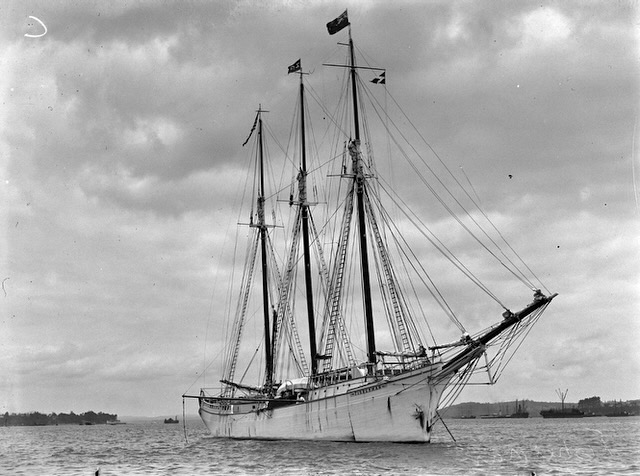 As my readers know, I live in Arizona, so it is only natural that I'm very familiar with the well-known author of Wild West books, Mr. Zane Grey. Grey wrote so many of the best-selling Cowboy stories from those days in the early 20th Century. We've seen them made into movies ("Riders of the Purple Sage" and many others) and know that John Wayne's cowboy persona was usually based on Grey's characters. His novels and written exploits made him quite wealthy.
The author used some of that wealth to purchase a 114-foot schooner, The Fisherman (photo above in Waitematā Harbour, New Zealand 1927) which he used to travel the world. Grey chose to travel the "little known" waters of the day, which often meant that he did a lot of exploration around the islands of the Pacific and Australia/New Zealand. The mid-to-late 1920's were still early in our radio history and explorers like Grey and others thought that radio amateurs could put this new "miracle of communication" to work as an aid to their exploration. This was true of the Arctic, Africa, or in Grey's case, the waters of Oceania. Those early explorers and their radio teams then became the first of our DXPeditions. This is the story of one of those first DX trips to the middle-of-nowhere.
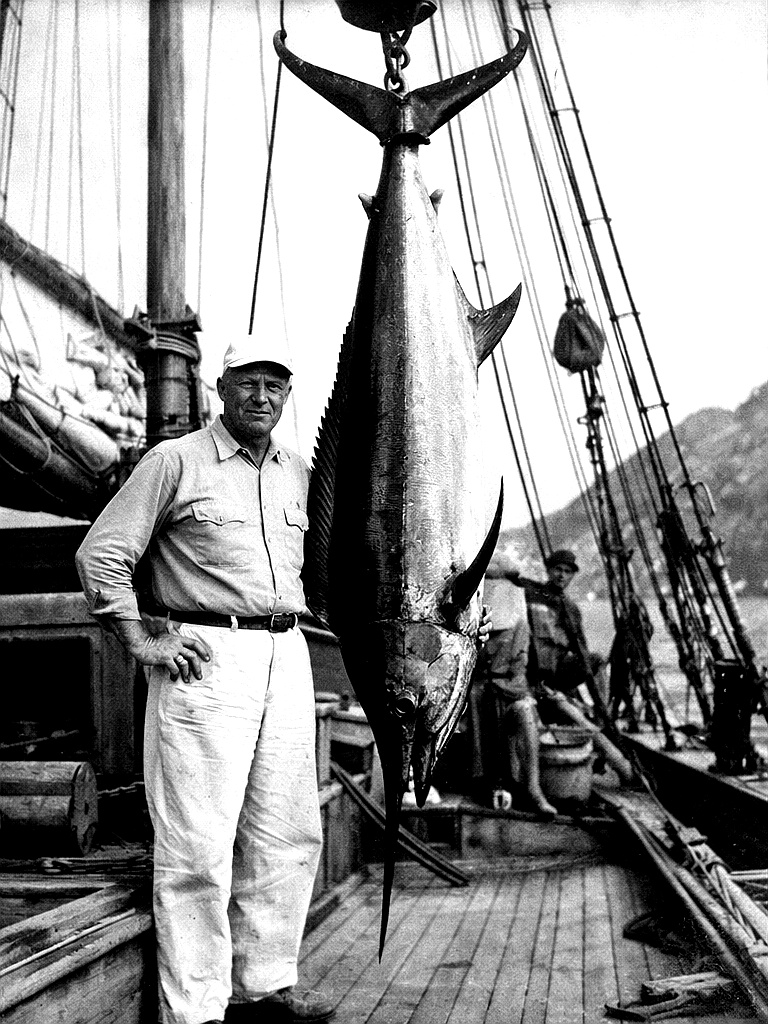 I will include sports fishing records in my discussion of Zane Grey because he is still known for his fishing expertise as well as the novels he wrote on board The Fisherman. Grey pioneered some of the methods still in use today to land the really big ones. He brought sport fishing into the limelight and increased the public's interest in the hobby.
Outfitting The Fisherman for World DX Radio
Zane Grey was not himself a ham. But like many other explorers, he recognized that amateur radio could be a great benefit to The Fisherman as it traveled throughout the South Pacific on what was labeled as a "semi-scientific" journey. Just as MacMillan had done before his exploration of the North Pole, he approached the radio community in order to find not just a station for his schooner, but a radio operator who would see this as an opportunity to make history on the air.
For that honor, he selected Karl E. Zint [6ZCB, and later W6ZCB] who then operated station KNT from onboard The Fisherman. Zint was a young man at the time, barely out of his teens. Despite his young age, he came on board with a solid understanding of the electronics involved in both amateur radio operation as well as commercial broadcasting. The January 2027 issue of QST described Zint as a "glutton for QSO's," and because the ship also carried a commercial transmitter on board, Zint could use his prior experience operating in that world as well. Another source described Zint as "one hell of a commercial brasspounder."
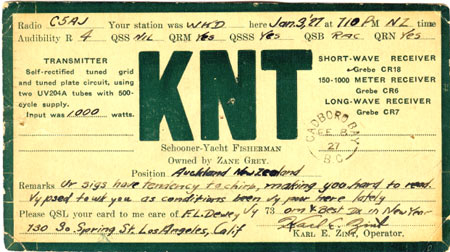 It took a year to outfit the schooner for its intended mission, which included the time to get a state-of-the-art station installed -- a Los Angeles commercial radio dealer was told to look for "nothing but the best." That 1927 issue of QST describes the station very specifically: "The transmitter uses two quarter Kw. tubes in a 500-cycle self-rectifying circuit. The wave!ength range ls from 15-60 meters. Along the operating table, the receiving equipment was carefully selected in order to cover the entire range of wavelengths in use today. Everything was designed with neatness and efficiency as of equal importance."
The antenna remains a bit of a mystery to me; perhaps a reader can illuminate in our forum what design this may be implying. Here's how it is described in the literature: "The antenna presented quite a problem. 0n the foremast, a cross spar as wide as the boat was installed and from this the antenna drops directly to the transmitting room on the starboard side of the ship. Operation is on the fourth harmonic of the antenna."
Zint wanted as much freedom as possible for his transmitter frequency, as he was uncertain what conditions would be in that part of the world . . . I am assuming his choice of antenna would reflect that flexibility. Once The Fisherman reached islands in the South Pacific, Zint found that 40 meters was the best use of his transmitter power and as a result that band is where 70% or more of his many logged QSOs took place on this DXPedition.
Not all the specialized equipment on board The Fisherman was radio gear. The mission as set about by Zane Grey had a scientific underpinning, as Grey considered himself a true explorer. But he was also an avid fisherman. Therefore, there was a good deal of newly designed fishing apparatus -- new types of rods and reels, a specially designed chair for the one with a line in the water, and other equipment that he hoped would allow him to bring home new and very different kinds of fish, He knew how large those ocean dwellers could get as he lived on Catalina Island in Southern California. Therefore he had installed large, custom tanks on board The Fisherman. Grey hoped his journeys would fill those with as-yet-unnamed fish species from the waters of the South Seas.
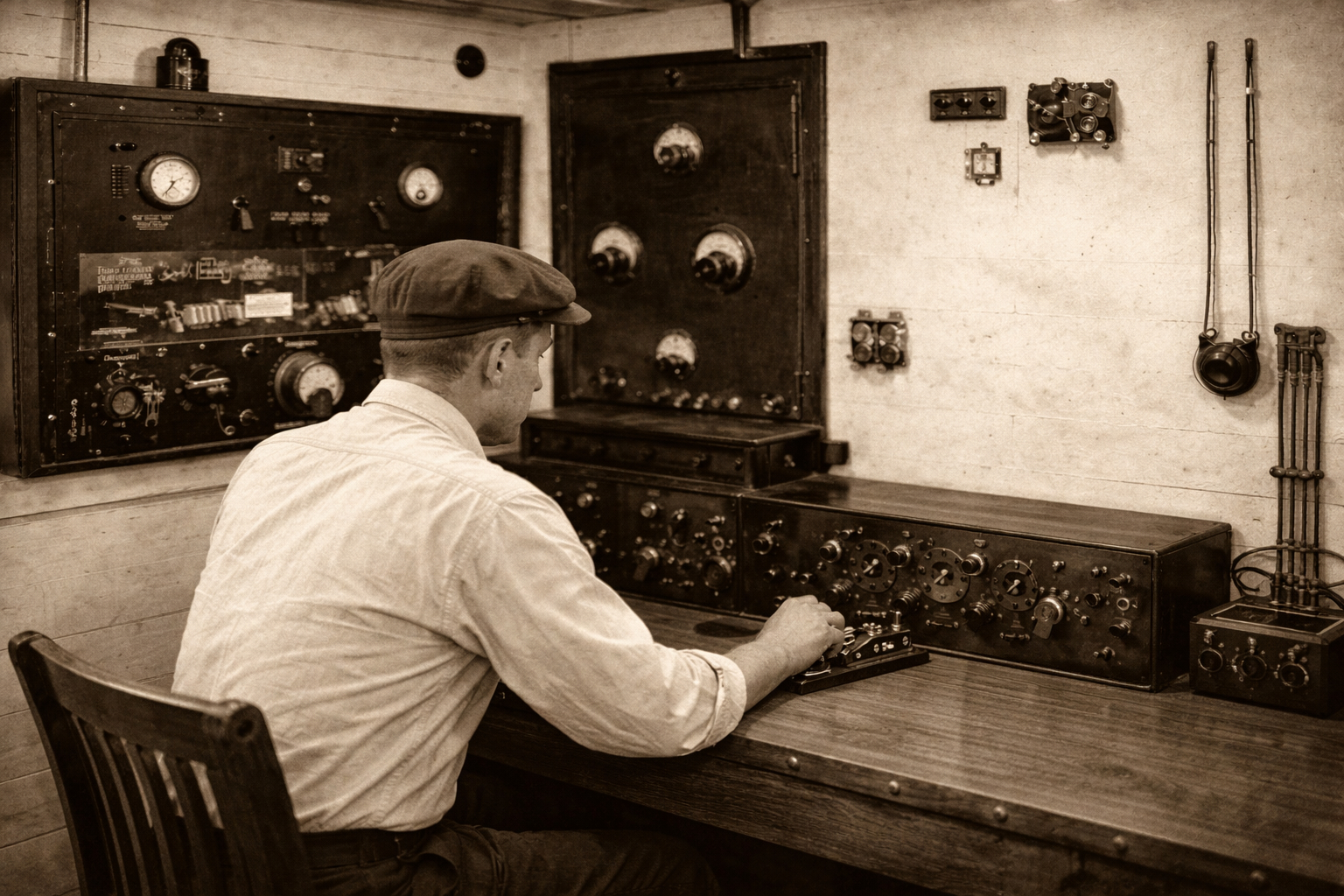 The Fisherman Leaves Southern California Headed for Oceania
On the morning of November 9th, 1926, The Fisherman left Long Beach, California, headed for the South Seas. Radio communication was quickly established with US amateur radio operators as they began their voyage. It was Karl Zint's intent to stay on the air as much as possible during both day and night using both amateur and commercial rigs. (Photo shown is ChatGPT produced, but based on an old QST image of how the radio room was set up on The Fisherman.)
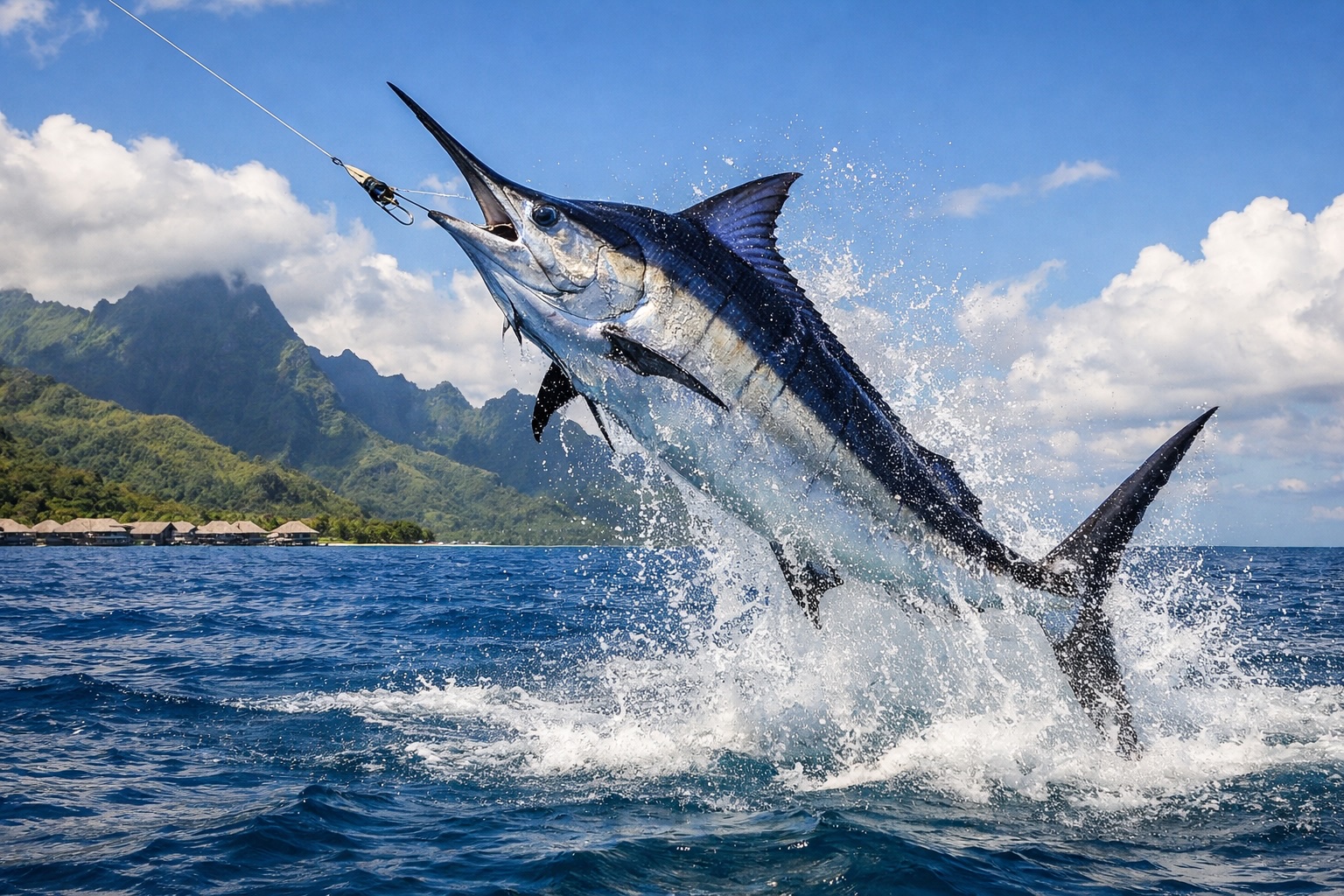 Upon reaching the Tahitian islands, Grey heard about the mythical Tahitian Striped Marlin, but went over 80 days without a bite. Others had caught some large Sharks, Wahoo, and Tuna, and one good-sized Marlin had been hooked but lost. It was really getting to Grey, but patience is a key attitude of the successful fisherman. It was a morning in May when one simply gigantic fish took his Bonita bait and started pulling the schooner along. Grey was using a large wooden rod with a huge reel capable of holding 1500 feet of 39-thread line (117-lb test linen with 42-thread, 126-lb test backing line.) The battle lasted for a number of hours, and over that period the gigantic fish leaped more than a dozen times out of the water. They thought they had lost him when he took a dive under the boat, which had gone more than ten miles since the fish was hooked earlier that morning.
In Conclusion
Zane Grey -- His impact on sport fishing includes over a dozen world records for big game fish. His ideas include the hookless, artificial, or natural baits used to attract billfish or sharks to the surface (called Teasers). He also worked with manufacturers to develop reels capable of holding 500+ yards of line to fight these massive fish, including specialized hooks he designed for broadbill swordfish. Most importantly, he established the foundation for deep-sea angling and those sport fishing techniques that are still being used 100 years later.
Karl Zint [W6ZCB] -- Karl was instrumental in keeping The Fisherman in touch with both hams and newspapers who were following the mission as it moved over the course of many, many months throughout the South Pacific islands. Upon his return, Karl moved to the Motion Picture world, a booming industry in his native Southern California. IMDB shows how Zint took on multiple roles over the years in Sound Design for the "talkies" of the day, including films invested in by Zane Grey. He became a Silent Key in 1978.
Thanks and VY 73, Dave W7DGJ