







to QRZ
Latest Awards




Trials & Errors #88 (10/27/26): 15,000 Petitions to the FCC!
I've always wondered how I could play radio if my eyesight ever worsened. I've got macular degeneration, but I can still see my knobs, dials and connections in the shack. I've met blind hams in Hamfests and on the air, so I know that I could continue to enjoy the radio as long as I can listen and click the PTT button or handle a paddle. But what if I couldn't hear anything? I'd be forced to use FT-8 every time I get on the radio!
Thinking about hams with disabilities got me to wonder about the difficulty of working the bands for the hard-of-hearing person. Today there are haptic devices where one can detect code physically, but that wasn't the case in the early years of amateur radio. That's why this story of Adolph Czajka in Chicago is so interesting.
 I read about Adolph in the late 1930's pages of an old Radio magazine (Radio, January 1935 edition.) The story contained a call-to-arms for amateur radio operators to support Czajka's request for a ham license despite the fact that he couldn't understand the code as presented in the FCC license tests of that day. He aced the written exam but flunked because he couldn't hear the code, which doesn't seem fair.
Like all those we feature in this column, Adolph was a uniquely talented radio enthusiast.
CW Becomes Visible with Signals on Paper Tape
Adolph Czajka had always had a fascination with the concept of radio, but as he was completely deaf, he had no way to understand what was being transmitted from those commercial or amateur stations. He had been able to afford a shortwave radio despite a very modest income as a WPA Electrician. (WPA was the "Works Progress Administration," a depression-era program to put the unemployed to work in the trades. They were given government jobs once trained, but generally received far less salary than those jobs usually paid.) I've attached a photo of Adolph in his shack from the original in Radio; it has been cleaned up with ChatGPT for publication.
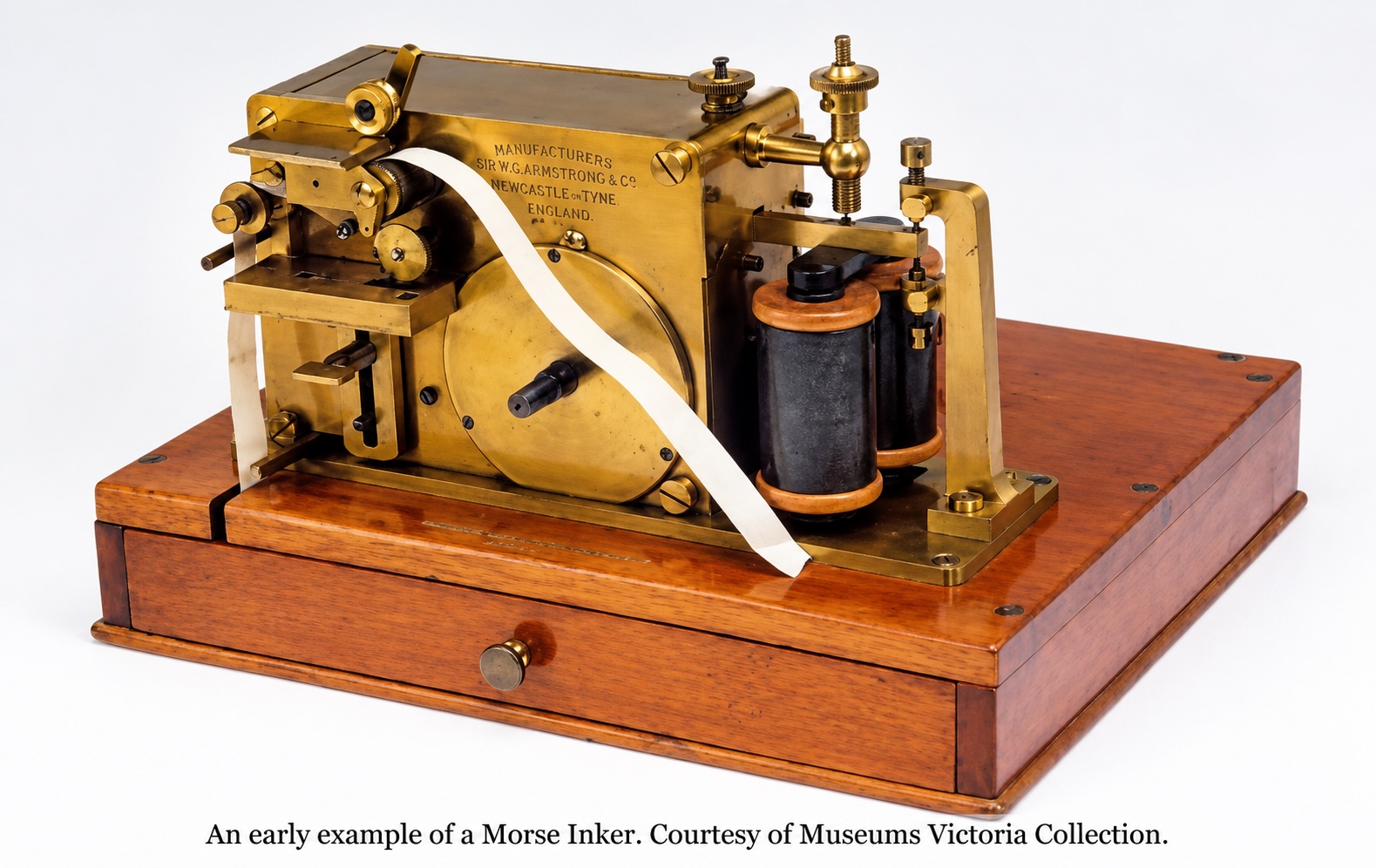
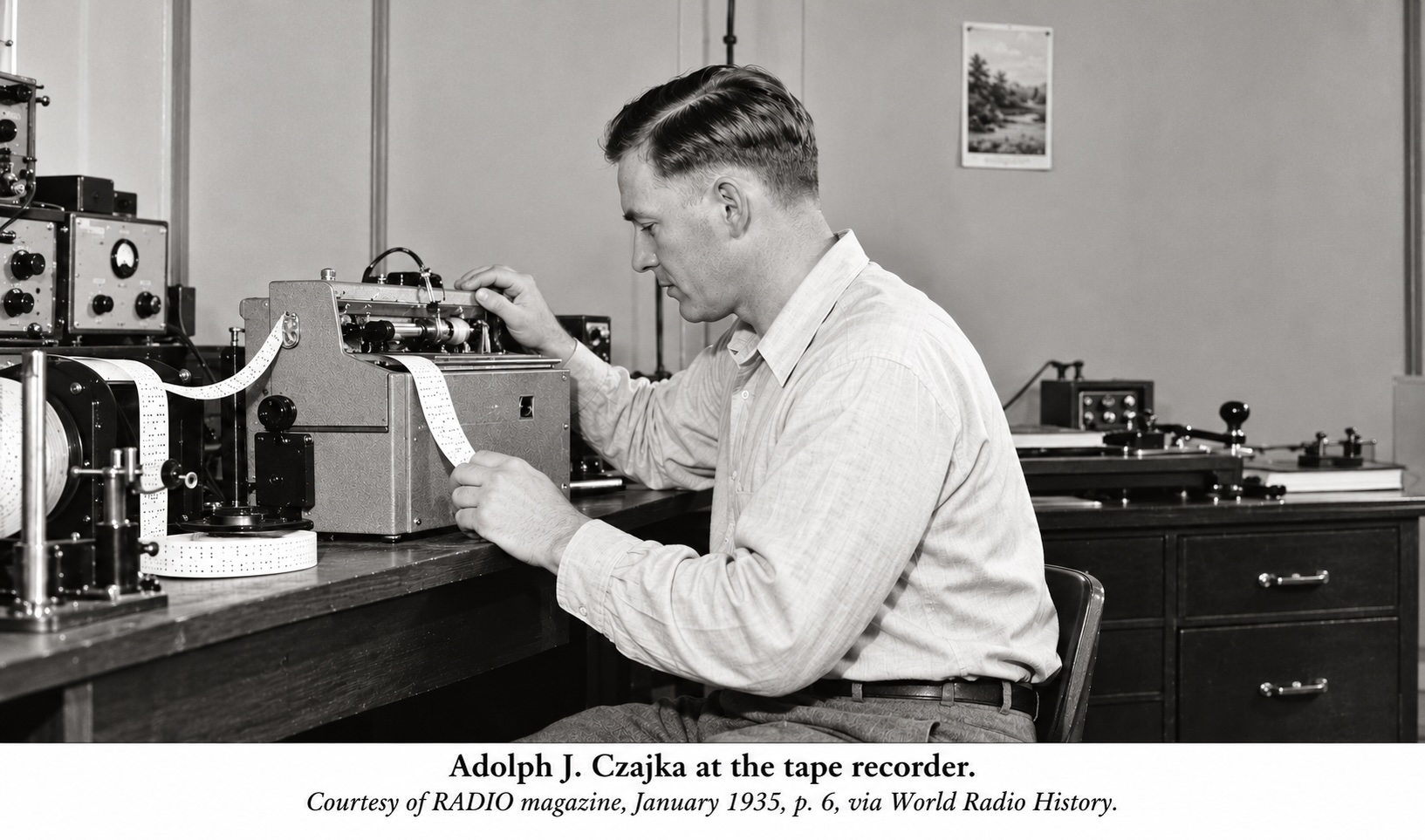 After the multiband radio came into the home, he began to tinker with ways to transfer the signals of radio amateurs onto a paper tape. As an electrician, it wasn't a stretch for him to figure out a way to convert a Morse Inker of his own design to read wireless. (The original Morse Inker had been designed for telegraph offices or government use. It was an interesting device on its own -- see sidebar below).
Adolph learned the code by watching his paper tape and became quite good at sending CW as well as receiving via his unique mechanism. But try as he might, he could not get anyone at the FCC to listen to his plea to secure a ham license. In an absolute groundswell of support from the amateur radio community, thousands of letters were sent to the FCC by the 1935 date of publication. Most of that activity came through the efforts of clubs and individuals who were in touch with Adolph via the US Mail.
Mr. Czajka built quite a collection of QSL cards by writing the hams he heard on the air. He would send them the paper tape of their morse transmissions -- something you certainly don't see every day. (I'd love to get a tape of my own "fist" to see how badly I slur my dashes or miss out on proper spacing). All of that, and more, would have been visible to hams who received his request for a QSL -- despite the fact that they didn't actually talk to him on the air.
Adolph built his first Morse Inker in 1925, and as he said in the interview from Radio, he'd been a "student of radio for more than a decade, without ever sending one transmission." He was "itching" to build a transmitter, but all of his design efforts had gone into the paper tape mechanism -- a device which gave him that huge collection of nearly 1,000 QSL cards from 36 countries. Hams receiving his unique letter and paper tape recording of their transmissions were astounded and generally wrote him back in support of his interests to become a licensed ham.
Accolades
Station W8IZE in Pennsylvania wrote to Adolph, stating: "Thank you very much for your tape recording of my signal. While examining the tape, I noticed that I have a tendency to hold the last dash on "8" as well as "W" and "Z." I am glad to know that and I will endeavor to improve my keying. Sure hope you are successful in obtaining a special license to operate." Station W8LDH in Michigan wrote back indicating a strong push from his end for Adolph's licensing quest . . . "I have shown your letter to various local hams and they all think you should have a license. We are willing to do anything in our power to help you."
And 15,000+ hams did exactly that.
The Result of Adolph Czajka's FCC Request
The January 1935 Radio article establishes that he had previously been refused a license because he could not hear the required Morse-code examination. It also documents the campaign to obtain an exception for him. Unfortunately, no matter how hard I looked and the many resources I combed through (both manually as well as with AI assistance) I was unable to find any evidence that the FCC did finally issue him a license.
In looking at the historical records through NewspaperArchives.com, I was able to identify a fairly big reason why this campaign of the amateur community did not bear fruit.
The interview in Radio took place when Adolph had two children and "a very nice wife," as he stated. When looking through the Joliet (IL) newspaper records, I found that his wife had a short time later given birth to a son, John, who was still an infant when Adolph tragically died.
He was walking home one evening and had just crossed a yard near his house. As he headed further up his street, an automobile swerved off the road and killed him instantly. The driver reported that he had been temporarily blinded by the lights of an oncoming vehicle, but of course Adolph had no ability to hear either vehicle. It was a loss to the radio community and to the Czajka family. He was only 41 years old.
Interestingly, I found a letter to the editor in the local newspaper that was written by him in 1938, not long before his death. His words reflected the attitude of many that war was coming to Europe.
"There is no such thing as peace. The only peace on earth is a piece of cake, or a piece of pie. We have commercial wars, political wars, hate wars, and family wars, to say nothing of wars we don't know anything about. Life is war."
Thanks for reading, and 73 for now,
Dave W7DGJ (A special request for assistance. If you've enjoyed reading this article, or you've got a grumble or two, I need you to post something in the forum link below. As a writer, I need feedback. Good, bad, ideas for future content, and so on. Thanks for taking another moment - it would sure be appreciated!)